



Quick Summary
Since many companies have started using Agentic AI in their core workflows now, it has become important for leaders to measure its performance and prove that it’s creating real business value, not just impressive demos. Metrics like automation rate, resolution time, and adaption rate help to calculate and communicate Agentic AI ROI effectively to all the stakeholders. The recent global trends also suggest that companies are treating governance and security as a strategic requirement for scaling agentic AI, not just a compliance checkbox. Today, global leaders need stronger controls and continuous monitoring to ensure that these agents remain reliable and accountable at scale.
There is an interesting shift happening lately that is reshaping the way global leaders approach Agentic AI. This shift is about leadership focusing more on speed and measurable outcomes from implementing agentic AI into their core workflows rather than experimenting with it. Which is why calculating and communicating ROI is becoming important, not just to justify investment, but to prove impact, earn stakeholder confidence, and scale agentic AI responsibly across the enterprise.
As Gartner estimates that by the end of 2026 almost 40% of the of enterprise applications will include task-specific AI agents, which shows how spending on AI will grow in the coming years. However, as budgets rise, accountability also increases, which is why global leaders now need clear proof of ROI, not just pilot results. Analysing agentic AI adoption stats and emerging trends will help to scale these agents effectively to achieve measurable ROI.
The Business Value of Agentic AI ROI
Business value, in simple terms, means real impact that you can measure, for example, lower costs, faster turnaround times, higher throughput, and fewer errors. And that’s exactly where agentic AI directly ties to ROI, when agents can run workflows end-to-end, organizations don’t just “work faster” but actually improve the unit economics of delivering services across the enterprise.
But the value is not just tangible. Agentic AI also delivers intangible advantages that compound over time, like better employee and customer experience, more consistent execution across teams, fewer bottlenecks between departments, and stronger governance and accountability as work scales. All these benefits don’t always show up immediately in a single KPI, but they materially improve reliability, agility, and decision velocity.
Many companies are already seeing these results in the first few years of implementation. Recently, in Google Cloud’s 2025 ROI of AI findings, 52% of executives reported their organizations are already deploying AI agents in production, which shows that agentic AI is moving beyond pilots into real operational rollout.
Are you tracking the true ROI of your AI initiatives?
Book a demoKey Metrics Used to Measure Agentic AI ROI
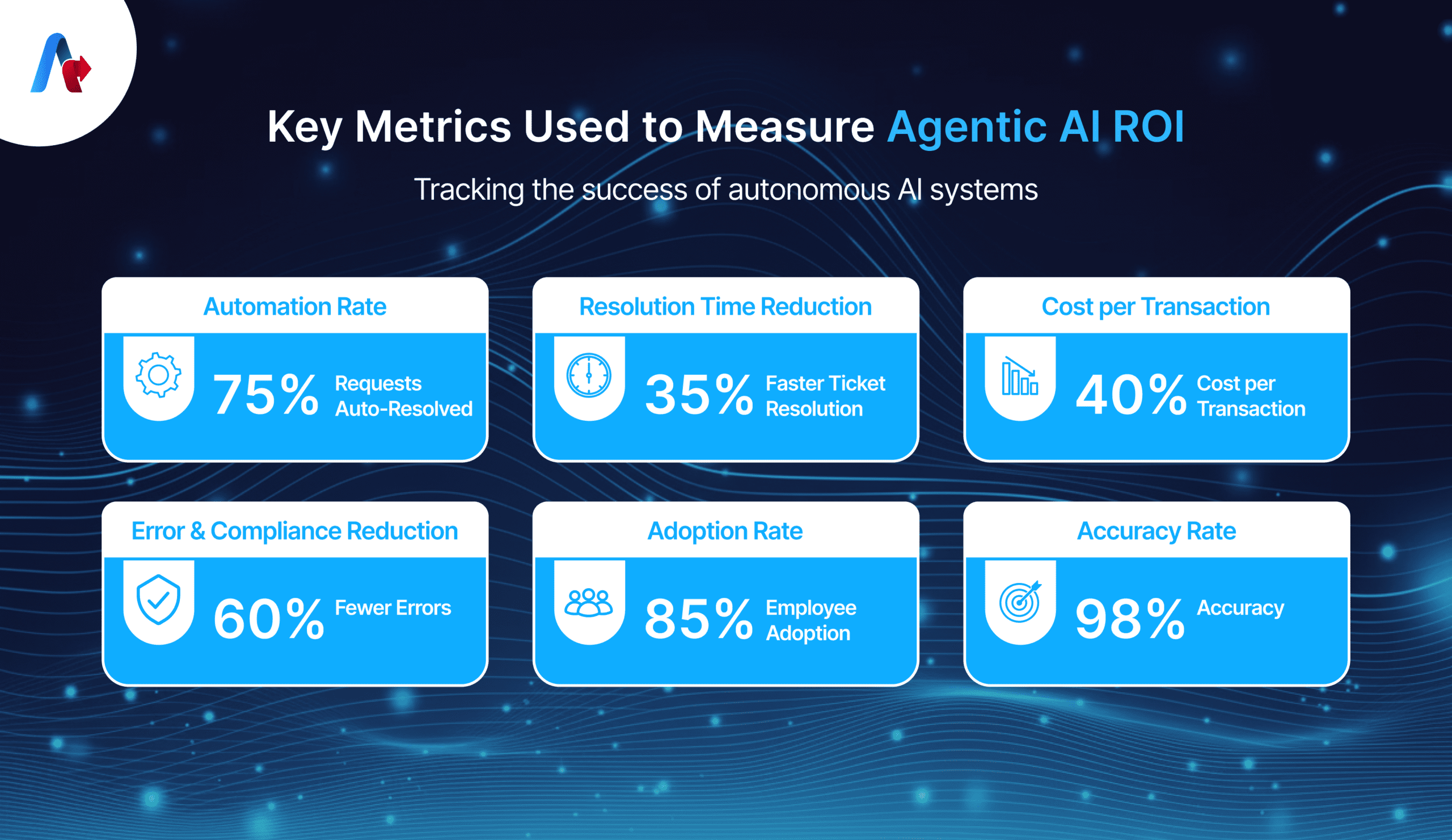
Here are some key metrics organisations should track to calculate ROI of agentic AI:
- Automation Rate: It calculates how much work is completed automatically by AI agents without human help, indicating better scalability and lower human efforts.
- Resolution Time Reduction: It calculates how fast a task or ticket can be resolved with the help of AI. Lower resolution means better service and fewer delays.
- Cost per Transaction: It helps to evaluate how much it cost the organisation spends to complete any task or request.
- Accuracy Rate: It measures the effectiveness of the agents by tracking the number of tasks it completes correctly in one go without rework, corrections, or human escalation.
- Error or Compliance Reduction: It calculates the number of policy violations or documentation errors that have reduced after deploying AI, indicating lower risk and higher efficiency.
- Adoption Rate: This metric shows how many employees are actually using and trusting the AI system, indicating a higher trust, system usability, and long-term ROI viability.
Frameworks for Calculating and Communicating Agentic AI ROI
The following steps will help you calculate and validate Agentic AI ROI in a effective way:
Step 1: Establish Clear Baselines for Agentic AI ROI
Before deployment, capture 3–6 months of historical data for key workflows. Metrics such as resolution time, cost per transaction, automation levels, error rates, and satisfaction scores create the foundation for measuring Agentic AI ROI.
Step 2: Define Outcome-Aligned KPIs to Track Agentic AI ROI
Organizations should track KPIs like automation rate, cost avoidance, cycle time reduction, and compliance improvement, which directly help to measure cost savings and efficiency gains.
Step 3: Conduct Pre- and Post-Deployment Comparisons
The easiest way to measure Agentic AI performance is to compare workflow results before and after implementation. Improvements in resolution time or reductions in cost per transaction show the organization is achieving measurable efficiency gains and real ROI.
Step 4: Quantify Tangible and Intangible Components of Agentic AI ROI
Leaders should track both tangible and intangible value while calculating Agentic AI ROI. Tangible gains include cost savings, faster task completion, and reduced workload, while intangible gains include better employee experience, stronger compliance, and faster decision-making.
Step 5: Tailor ROI Communication to Stakeholders
Different stakeholders care about different outcomes, which is why these ROI reports must be tailored and communicated to every stakeholder according to their priorities. This will help to scale agentic AI more easily and effectively.
Real-World Enterprise Deployments with Agentic AI ROI
Here’s how organizations are applying agentic AI in real-world deployments to drive measurable ROI:
Healthcare
Adoption is already strong, as almost 68% of healthcare organizations report using AI agents to handle documentation, inpatient monitoring, early health warnings, and workflow coordination between departments. These agents help to gather patient data, trigger alerts, assist with notes, and streamline administrative tasks automatically. It results in lower operational costs, faster care delivery, and improved clinician productivity.
Banking, Insurance, and Financial Services
AI spending across financial services is projected to reach $97 billion by 2027. These agents are being used in high-volume, rule-heavy workflows like fraud detection, loan processing, compliance checks, claims management, and personalized customer interactions, which directly affect risk and revenue. This helps to reduce manual workload, shorten decision cycles, and improve customer experience, all of which directly impact ROI.
Retail and E-Commerce
According to IDC, 41% of organisations are already investing in AI agents, particularly in service and case management operations. Instead of routing customers through multiple teams, these agents help to manage customer service calls, handle order issues, coordinate returns, trigger marketing messages, and optimize digital storefront interactions. For retail, this means faster response times, fewer escalations, higher customer satisfaction, and measurable gains in sales and operational efficiency.
Supply Chain & Logistics
Leaders in the supply chain are integrating agentic AI into shipment monitoring, inventory control, demand forecasting, and exception handling. The AI agents can automatically analyze data from different systems, predict possible disruptions, and adjust decisions accordingly. This has led to a 15% decrease in logistics expenses and a 65% increase in service levels.
IT & Cybersecurity
IT departments are natural early adopters of agentic AI. From password resets and access provisioning to ticket triage and cybersecurity monitoring, these agents can carry out workflows across systems without constant human intervention. According to a recent PwC study, almost 53% of U.S. businesses deploying AI agents are using them in IT and cybersecurity. This shows that enterprises are seeing IT as a practical starting point for agentic AI
Enterprise Agentic AI Adoption Trends & Market Benchmarks
As enterprises expand their agentic AI initiatives, new trends are reshaping how organizations approach deployment. Here’s what’s changing:
- AI is starting to handle real work on its own: Gartner says that by 2029, agentic AI could resolve 80% of common customer service issues without human help, that’s a big shift from just assisting to actually executing.
- Agents are becoming part of everyday software: By 2028, one in three enterprise applications will have agentic AI built in, meaning more daily decisions will happen automatically.
- Companies feel pressure to scale fast: 93% of leaders believe that the ones who scale AI agents in the next year will pull ahead of their competitors.
- This isn’t just a tech industry thing anymore: PwC reports that every industry is expanding AI usage, even sectors that weren’t traditionally AI-focused.
- Budgets are going up: 88% of executives say they plan to increase AI spending in the next 12 months because of agentic AI momentum.
- AI agents are being seen as the new enterprise apps: Many organizations now view agents as a core layer of how work gets done, not just another tool.
- Governance is becoming important too: As agents get more autonomous, companies are investing more in oversight and control to scale safely.
Facing challenges scaling agentic AI across teams?
Call our experts today!Challenges and Pitfalls in Measuring Agentic AI ROI
While agentic AI can deliver measurable impact, many organisations still struggle to quantify and communicate its value correctly. Without a structured approach, ROI efforts can stall, leading to wrong expectations. Here are some of the common challenges:
- Lack of Clear Baseline Data: It's difficult to measure the impact of agentic AI without having a clear baseline for comparison.
- Overemphasis on Cost Savings Alone: Focusing only on cost reduction can hide the bigger ROI with agentic AI, such as better productivity, quality, and long-term agility.
- Fragmented Measurement Across Departments: Tracking the overall impact of AI across the organization becomes difficult when teams measure results separately for every department
- Underestimating Change Management Impact: Adoption rate stays low if employees are not properly trained or encouraged to use AI agents, which impacts employee performance and overall ROI
- Overpromising Without Infrastructure Readiness: The overall performance and impact of AI fall short without having strong data, system integration, and governance
- Failure to Track Long-Term Compounding Value: AI impact grows over time as more workflows are automated, but short-term measurement may miss this expanding value.
Scaling Strategies to Maximize Enterprise ROI
When agentic AI meets ROI, scaling becomes a strategic priority, not just a technical rollout. Here are the key strategies enterprises use to scale effectively and maximize long-term impact:
- Start with High-Impact, Repeatable Use Cases: Start with workflows that are high-volume and easy to measure, so early results clearly demonstrate value.
- Horizontally Across Departments: Gradually extend agentic AI to other functions to increase the overall ROI of the organisation
- Build a Centralized Governance Framework: Put clear policies in place for data access, compliance, and oversight to ensure safe and consistent scaling.
- Continuously Optimize Through Feedback Loops: Regularly review performance data and refine workflows to improve efficiency and
- Treat Agentic AI as Infrastructure, Not a Tool: Embed AI deeply into core systems so it becomes part of everyday operations, driving long-term scalable value
- Invest in Workforce Enablement: Organisation must train its employees and promote adoption of automation, so it is actively used and delivers measurable impact.
Do you have a clear ROI framework for agentic AI?
Book a demoFuture Trends: What’s Next for Agentic AI ROI Measurement
With the increasing adoption of agentic AI, the way we calculate ROI is changing from traditional efficiency metrics to more integrated, enterprise-wide value models. Organizations have started to evaluate the combined performance of multi-agent ecosystems rather than isolated automation rates, tracking how coordinated agents influence end-to-end process velocity, revenue contribution, and cross-functional outcomes.
Measurement frameworks are also evolving to include predictive ROI modeling, which uses data to forecast expected returns before full deployment, that allows enterprises to prioritize high-impact workflows with greater confidence.
When agentic AI meets ROI, companies look beyond cost savings and also measure employee experience, customer satisfaction, and risk reduction. Over time, ROI reflects long-term growth, agility, and competitive advantage, not just short-term savings.
Now Scale Your Agentic AI Investment with a Clear ROI
Agentic AI is no longer just about experimentation; it's also about delivering measurable results. Organizations that track the right metrics, set clear baselines, and scale strategically are able to see improvements in terms of efficiency, productivity, and long-term growth.
At Accelirate, we help enterprises move from pilot projects to scalable agentic AI strategies that focus on driving measurable ROI and business value.
Start measuring your Agentic AI ROI with Accelirate and turn innovation into real, quantifiable impact.
FAQs
Enterprises typically achieve 20–40% automation rate improvements, faster processes, lower costs, and improved accuracy. Mature deployments also enable scalability without increasing headcount.
They use agentic AI to automate IT, HR, customer service, and cross-functional workflows. The goal is end-to-end execution, not just task assistance.
Yes, when implemented with clear goals and proper measurement, organizations can achieve higher efficiency, productivity, and reduction in cost within the first year of deployment.
Compare the results before and after implementation in terms of cost, speed, automation, and quality. This will help you measure the ROI in a credible manner.
Agentic AI ROI (%) = [(Cost Savings + Productivity Gains + Risk Reduction Value) – Total AI Investment] ÷ Total AI Investment × 100
Most enterprises see measurable ROI within 6–12 months when deployed in high-volume workflows with defined KPIs.