



Quick Summary
Supply Chain is the backbone of every business, but even small ERP or WMS changes can cause fragile automations to break. Auto-healing bots safeguard operations by instantly detecting and fixing issues, adapting to system shifts, and learning from disruptions. It reduces delays, costs, and ensures that all critical processes like inventory management, order fulfillment, logistics, and forecasting run smoothly. The outcome is true supply chain and network optimization, delivering resilience, efficiency, and long-term reliability.
Recently, a global retailer pushed a small ERP update, just a tweak for faster reporting. Immediately the next morning, chaos erupted. The bots handling shipment tracking and purchase orders broke down, forced warehouses to scramble to manual entry, and left customers in the dark. A small update caused chaos, delays, loss of revenue, and impacted customer satisfaction.
The real problem was not the ERP update, but the weak so-called “optimized” supply chain automations. The bots couldn’t adapt to even the smallest change, turning a tool for efficiency into a single point of failure.
The turnaround came when the retailer deployed auto-healing bots in supply chain operations. These self-healing bots detected selector drift, restarted themselves, patched timing gaps, and even suggested fixes. Instead of collapsing under system tweaks, the automations adapted on the fly, transforming disruption into resilience and delivering true supply chain optimization.
Why Most Supply Chain Automation Optimizations Fail Under Pressure
Most CEOs and CTOs believe their supply chains are optimized. They’ve invested heavily in ERP, WMS, RPA, and dashboards. On the surface, everything seems efficient. But even a small system tweak, UI change, or surge in orders can expose fragility that ripples across the business.
In truth, much of what’s called supply chain optimization is just a patchwork of brittle automations. These setups perform under stable conditions but crack under disruption, making real supply chain network optimization more than dashboards and bots. It’s about fixing the hidden inefficiencies that quietly drain performance:
- Overreliance on old automation –Traditional RPA bots break whenever ERP or WMS screens shift. A single selector drift can halt an entire order-to-cash process.
- Slow response to disruptions – By the time teams find any broken workflow or stalled shipment the company already starts suffering revenue leakage and delays.
- High manual fallback costs – There has to be human intervention every time there is any bot failure, which causes errors, higher labor costs, and slower fulfillment.
- Lack of adaptive intelligence – Legacy bots don’t self-correct. Each error requires developer intervention, dragging down agility.
- Missed opportunities for efficiency- Missed opportunities for efficiency – Old automations fail to improve and learn on their own, and repeat the same problems Across industries, these cracks prevent organizations from unlocking the real promise of supply chain automation optimisations.

Tired of bots breaking at the worst time? Let’s fix that.
Book a call with our expertsWhat Are Auto-Healing Bots in Supply Chain?
So, what exactly are self-healing bots? Self-healing bots use Agentic AI, allowing them to learn, adapt, and respond to changing conditions, unlike traditional RPA bots, which can only detect errors. Self-healing bots can do more than that; it can detect issues, fix selectors, retry steps, and use fallback methods to keep processes running. They are also able to record diagnostics and suggest permanent fixes in UiPath Studio or Orchestrator.
In simple terms, they heal themselves instead of waiting for someone to fix them. That’s why they’re so transformative for auto-healing supply chain automations. Instead of fragile scripts that collapse under disruption, you get adaptive, resilient automation that keeps critical workflows like order processing, inventory updates and shipment tracking, running smoothly, even during system updates.
Key factors that make self-healing bots valuable for supply chain optimization:
1. Adaptive Resilience
It does not collapse even when there is an update in ERP, WMS, or partner system. It can automatically re-map selectors or workflows and maintain continuity across order-to-cash and logistics processes.
2. Reduced Downtime
Self-healing reduces MTTR (Mean Time to Repair) from hours or days to seconds, cutting SLA breaches and avoiding costly revenue leakage.
3. Smarter Operations
Beyond healing in real time, these bots generate analytics on recurring errors, giving IT and operations leaders insights to eliminate systemic weaknesses.
4. Continuous Learning
Every time they heal themselves, they refine their logic, creating ongoing supply chain automation optimizations that make future disruptions less impactful.
5. Proactive Stability with AcceliOps
When layered with AcceliOps monitoring, QA testing, and data-driven insights, businesses unlock a double advantage: bots that auto-correct instantly, plus expert oversight that prevents repeat disruptions and drives long-term supply chain network optimization.
AcceliOps provides businesses with double benefits of real-time healing and long-term optimization
Real Examples of Supply Chain Optimization Using Auto-Healing Bots
Once the self-healing bots are in place, businesses could see real impact:
Inventory Management
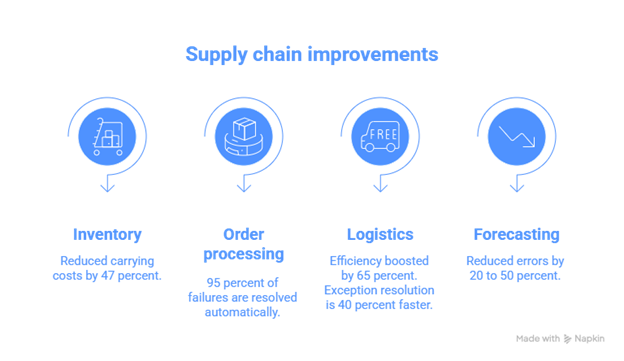
With self-healing bots, businesses could sync stock levels between ERP and WMS with zero failure during monthly updates. This means inventory data stayed accurate, forecasting models improved, carrying costs fell by 47% and SKU coverage expanded by 156%. It is a reliable starting point for leaders looking for efficient supply chain optimization.
Order Processing & Fulfillment
Previously, order intake bots often failed during overnight hours, leaving unprocessed orders until morning. With auto-healing bots in supply chain order fulfillment, issues were resolved 95% of the time without human touch. SLA breaches fell by 90%, and fulfillment timelines stabilized. Customers saw consistent delivery promises, and the ops team finally got to sleep at night.
Logistics & Shipment Tracking
Shipment-tracking workflows are notorious for breaking when carrier portals change layouts. With self-healing automation, those integrations adapted instantly. The retailer saw a 65% boost in order-processing efficiency, 40% faster exception resolution, and 50% shorter customer complaint cycles. That’s what true supply chain network optimization looks like: seamless visibility across partners.
Demand Forecasting
Agentic RPA bots automated data pulls from ERP, POS systems, and external sources. Instead of rigid weekly reports, forecasts updated in real time as conditions shifted. Forecast errors dropped by 20–50%, giving planners confidence to optimize production schedules and supplier orders. This is supply chain optimization using auto-healing bots in action — decisions backed by live, resilient data.
The Strategic Advantage of Self-Healing Bots
This is how self-healing bots helps leaders get the strategic advantage in 2026:
- Revenue protection: Every hour of downtime avoided protects sales and prevents customer churn.
- Agility: With auto-healing, supply chains adapt instantly to system updates or disruptions.
- Lower operating costs: Reducing human intervention allows teams to work on value-added activity and less on problem-solving.
- Future-proofing the enterprise: Adaptive automation helps businesses adapt to complexities and get a competitive edge
- Customer experience consistency: Bots that don’t fail deliver seamless, reliable service customers can trust.
In short, self-healing bots give CEOs and CTOs the confidence that their supply chain automation optimisations won’t crumble under pressure.
Auto-Heal Your Supply Chain for True Resilience
Supply chains are only going to get more complex due to global instability, shifting demand, and complex partner networks. Businesses who rely on weak automation will have to firefight problems. Whereas adopting auto-healing bots in the supply chain will help to build resilience, protect margins, and deliver a smooth customer experience.
The global retailer that nearly broke under one ERP update learned this the hard way. You don’t have to. With AcceliOps’ philosophy of enhancing existing systems, proactive monitoring, and self-healing at scale, the path to a truly autonomous, resilient supply chain is already here.
Because in the end, the real differentiator isn’t just automation — it’s automation that heals itself.