





If I look back to my early years in QA, automation mostly meant writing long, rigid scripts and maintaining fragile locators. Every minor UI change would send testers scrambling to fix scripts, creating delays and frustration. In today’s agile and CI/CD environments, that model no longer works. It’s simply too reactive.
In contrast, Agentic AI Testing changes the rhythm entirely. In our recent pilot implementations, we observed AI testing agents that didn’t just execute predefined steps, but actually interpreted requirements, explored applications, generated new cases on the fly, and reused prior context. They were even capable of suggesting smarter test improvements based on past patterns.
For a QA professional, watching this transition feels like moving from pushing a cart uphill every day to having a reliable co-driver who can anticipate the road ahead. It’s not about lessening human skill but amplifying it.
Cut QA costs by 40%.
Start todayHow Accelirate Is Driving Agentic Test Automation?
At Accelirate, we have the benefit of working across diverse enterprise test environments, which gives us perspective on what’s practical versus what’s theoretical. For our clients, the result isn’t just faster execution, it’s better coverage, reduced maintenance, and stronger alignment with business goals.
Our approach to Agentic AI Testing is rooted in real-world delivery:
- Integrating into DevOps pipelines so testing isn’t a bottleneck, but an enabler of continuous releases.
- Using generative AI and NLP to translate business requirements into executable test cases, cutting down manual effort.
- Designing gradual adoption strategies, starting with readiness assessments and pilot frameworks.
- Leveraging UiPath Autopilot and Test Suite to bring together manual, automated, and agent-led testing in a unified workflow.
Managing Client Expectations: A Test Manager’s View
When I work with clients on Agentic AI Testing, I’ve found that success comes down to clarity, collaboration, and trust. What I’ve learned is that adoption is as much about people and culture as it is about technology. Here’s the playbook I follow:
1. Requirement Understanding
I ensure we map client goals, be it speed, coverage, or resilience, to specific agentic use cases. This includes identifying which areas benefit most from autonomous exploration and test generation.
2. Tool and Data Readiness
I work closely with architects and DevOps teams to ensure we have clean data, stable environments, and tools like UiPath Test Cloud, Libraries and Object Repository in place for agent training and execution.
3. Incremental Rollout
I recommend starting with low-risk, high-visibility modules for agentic pilots. This builds trust and creates space for learning before scaling.
4. Human-in-the-Loop Governance
While agents are intelligent, oversight is essential. I establish checkpoints where test experts validate agent outputs, ensuring quality without giving up control.
5. KPIs and Feedback Loops
We track metrics like test coverage improvement, defect leakage reduction, and execution time. Regular feedback helps fine-tune agent behaviors and align outcomes with client expectations.
How Do We Test the Agent Itself?
This is a question I often get from clients: “If an QA testing agent is making decisions, how do we validate it?”
The answer lies in not just testing what the agent does, but how it thinks. My validation framework includes:
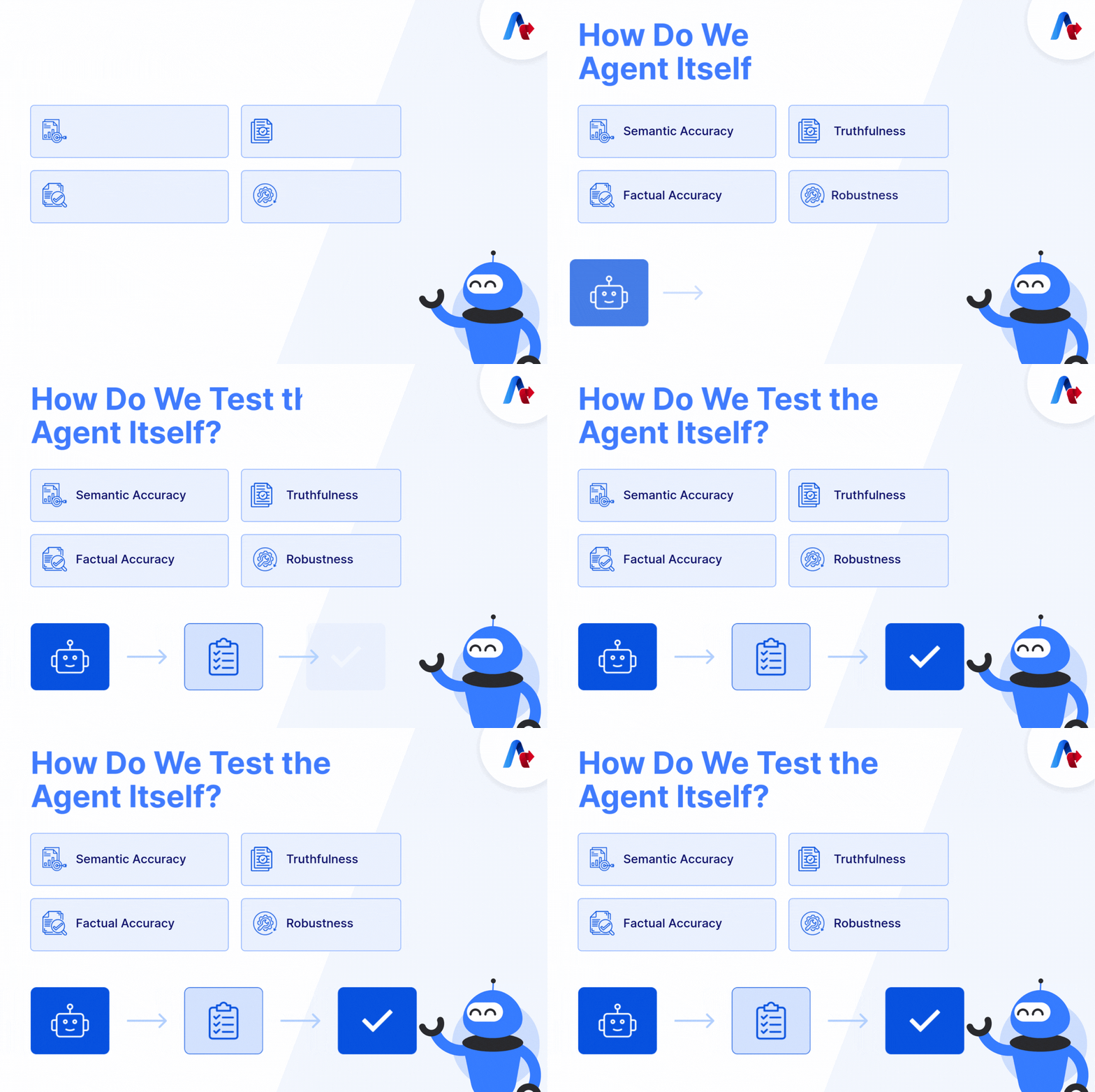
1. Semantic Accuracy
- Validate whether the agent correctly understands the intent behind user stories or requirements.
- Test multiple natural language prompts to see if the output remains consistent and logical.
- Ensure that test cases generated accurately reflect business rules, not just surface-level behavior.
2. Truthfulness
- Measure if the agent is producing factually correct steps in workflows.
- Cross-check generated test cases against system documentation or SME input to avoid false positives or misleading logic.
- Introduce “deliberate ambiguity” to test how the agent handles uncertainty without inventing wrong assumptions.
3. Factual Accuracy
- Are the generated test steps and validations factually correct based on system behavior and documentation? Is the logic based on truth, not assumptions?
4. Robustness
- Run scenarios where UI elements or data change, and evaluate how well the agent adapts or self-heals.
- Check if fallback logic or re-learning behavior kicks in as expected.
By treating agents as intelligent collaborators, not just executors, we ensure both trust and traceability that’s key for enterprise adoption.
Looking Ahead: The Future Is Already Here
To me, the promise of Agentic AI Testing Automation Testing is clear; it’s not about replacing testers, but empowering them. It lets QA professionals spend less time chasing brittle scripts and more time ensuring meaningful coverage, risk mitigation, and innovation.
As leaders, our role is to guide teams and clients through this shift responsibly, balancing excitement with governance, and innovation with structure. At Accelirate, with the power of platforms like UiPath and Tosca, we’re already helping enterprises reimagine testing as an intelligent, adaptive, and business-aligned function.

More Articles

Agentic AI in 2026: What Enterprise Leaders Must Prepare for
By 2026, agentic AI will move from pilots to production. Discover what enterprise leaders must prepare for as AI agents reshape business operations.
January 22, 2026

UiPath vs. Open Source: A Test Manager’s Perspective on Choosing the Right Testing Tool
Compare UiPath Test Suite vs open-source tools like Selenium, Rest Assured, and JMeter from a Test Manager’s perspective to choose the right QA and automation stack.
November 18, 2025

Tosca vs. Open Source: A Test Manager’s Perspective on Choosing the Right Testing Tool
Compare Tricentis Tosca with open-source tools like Selenium, Rest Assured, and JMeter. Learn how to choose the right testing tool for scalability, cost, and long-term ROI.
October 21, 2025