



Quick Summary
Field service operations are complex, often involving fragmented data, urgent timelines, and the need for accurate troubleshooting in real-time. Agentforce for Field Service, Salesforce’s AI-driven assistant, is designed to support frontline technicians with contextual intelligence, proactive guidance, and automation of repetitive tasks. By connecting data from CRM, IoT devices, and service histories, it enables higher first-time fix rates, faster onboarding for new technicians, and measurable improvements in customer satisfaction.
Salesforce for field service is the lifeline of industries like utilities, telecom, manufacturing, and healthcare. Yet technicians often arrive on-site with incomplete knowledge, scattered documentation, or pressure to meet rising customer expectations. According to a Service Council study, nearly 46% of organizations say incomplete or inaccurate information is their top challenge in field service.
Traditional approaches like static manuals, siloed systems, or reactive troubleshooting are no longer enough. Customers expect fast, first-time resolutions and proactive maintenance. This is where agentic AI in field service can make a measurable difference.
Salesforce’s Agentforce for Field Service represents a practical step forward; an AI-powered assistant that acts as a co-pilot, providing real-time answers, automating routine tasks, and supporting technicians in the field.
Give your technicians an AI assistant on the ground.
Start Today!What is Agentforce for Field Service?
Most companies already use CRM platforms or field service management tools, but these often act as repositories of information rather than active assistants. Agentforce for Field Service shifts the model by introducing autonomous, context-aware digital agents into technician workflows. Think of it as a digital partner in the field, always ready with context, always aligned with organizational goals, and always learning from past cases.
Instead of waiting for humans to search knowledge bases or manually log updates, these agents:
- Understand technician queries in natural language.
- Access and synthesize data from CRM, IoT devices, and service records.
- Recommend next best actions or resolutions.
- Automate routine tasks like logging visits, updating records, and generating reports.
Why Field Service Needs AI Agents More Than Ever?
The complexity of field operations has grown over time. Here are some of the common challenges that AI agents can help address:
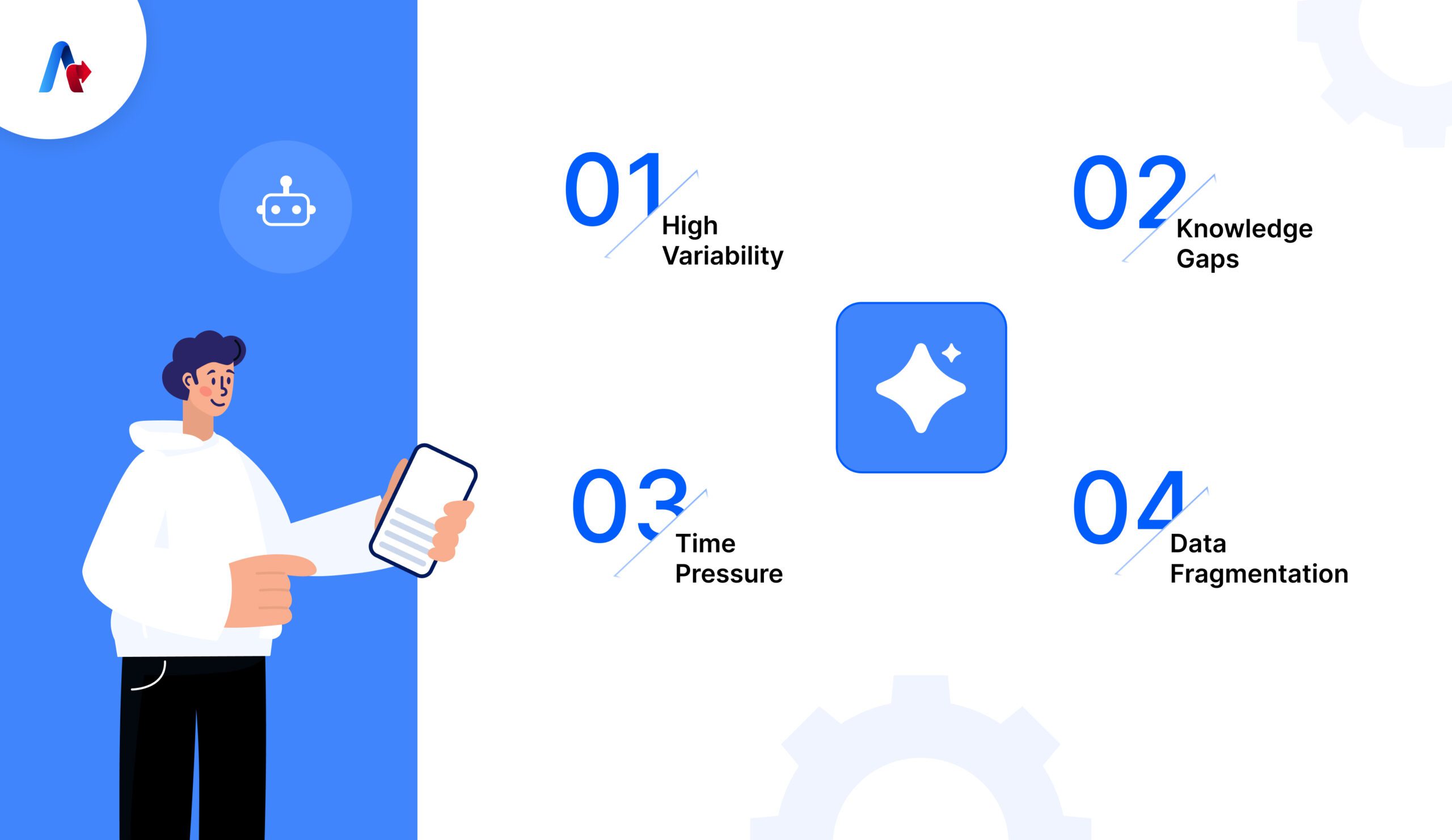
1. High Variability
Every service call is different. Equipment models vary, customer environments differ, and field conditions can change. Static scripts or manuals can’t account for all these variations.
2. Knowledge Gaps
Experienced technicians may carry valuable institutional knowledge, but newer staff often struggle. A Field Service News survey found that 41% of organizations face challenges onboarding new technicians quickly.
3. Time Pressure
Customers expect fast fixes and minimal disruption. Delays in troubleshooting or repeat visits directly impact satisfaction scores and service costs.
4. Data Fragmentation
Critical information, from IoT sensor alerts to service history, often lives in disconnected systems. Technicians waste time switching between apps or calling colleagues for answers.
Agentforce addresses these gaps by consolidating data and offering real-time, guided assistance. It’s not just about information retrieval, but actionable recommendations tailored to each situation.
Key Capabilities of Agentforce for Field Service
Let’s look at some of the most significant capabilities of Agentforce for Field Service that makes it the next best assistant for your needs.
1. Intelligent Troubleshooting
Instead of guesswork, AI agents analyze IoT signals, service records, and past tickets to suggest the most probable causes and resolutions. For example, if 70% of past issues in a region were caused by faulty connectors, the agent recommends checking connectors first.
2. Dynamic Workflow Guidance
Every technician has different skill levels, and every issue requires a tailored workflow.
Agentforce creates personalized, step-by-step instructions, ensuring even new technicians can handle complex jobs confidently.
3. Proactive Alerts
By integrating with IoT sensors, Agentforce shifts the model from reactive to proactive service. Agents can notify technicians about potential failures before they happen, enabling predictive maintenance and reducing downtime.
4. Automated Documentation
Manual paperwork remains a big drain on productivity. Agentforce auto-generates visit notes, time logs, and part usage records — saving technicians hours weekly while improving data accuracy.
5. Knowledge on Demand
Instead of searching bulky manuals, technicians can simply ask in natural language: “What’s the standard process for replacing this part?” The AI agent fetches the right answer instantly.
How would your customer satisfaction scores improve if repeat visits dropped by even 20%?
Let’s fix it today!How Agentforce for Field Service Works in Practice?
Let’s walk through a real-world example:
A telecom field technician is dispatched to resolve a customer’s weak fiber connection.
- Step 1: On arrival, the technician asks Agentforce: “What are the common causes of low signal in this neighborhood?”
- Step 2: Agentforce queries CRM, service history, and IoT network data, then replies with: “In the past 90 days, 65% of issues were due to connector faults. Recommended first check: junction box at pole #142.”
- Step 3: As the technician works, the agent automatically logs steps taken and updates the case record.
- Step 4: If the issue is complex, the agent suggests escalation protocols or connects the technician to a remote expert.
The result? Faster resolution, better data capture, and higher customer satisfaction.
Benefits of Agentforce for Field Service for Organizations
Organizations that implement Agentforce for Field Service gain multiple advantages:
- Increased First-Time Fix Rates – Real-time troubleshooting guidance reduces repeat visits.
- Faster Technician Onboarding – New hires quickly ramp up with AI-assisted learning.
- Improved Productivity – Automation reduces manual data entry by up to 30–40% (Salesforce Field Service Report, 2023).
- Customer Satisfaction – Faster service and proactive maintenance keep customers happier.
- Actionable Insights – Aggregated agent data highlights systemic issues and areas for process improvement.
Getting Started with Agentforce for Field Service
Rolling out an AI-driven assistant doesn’t have to be overwhelming. Salesforce recommends a phased approach:
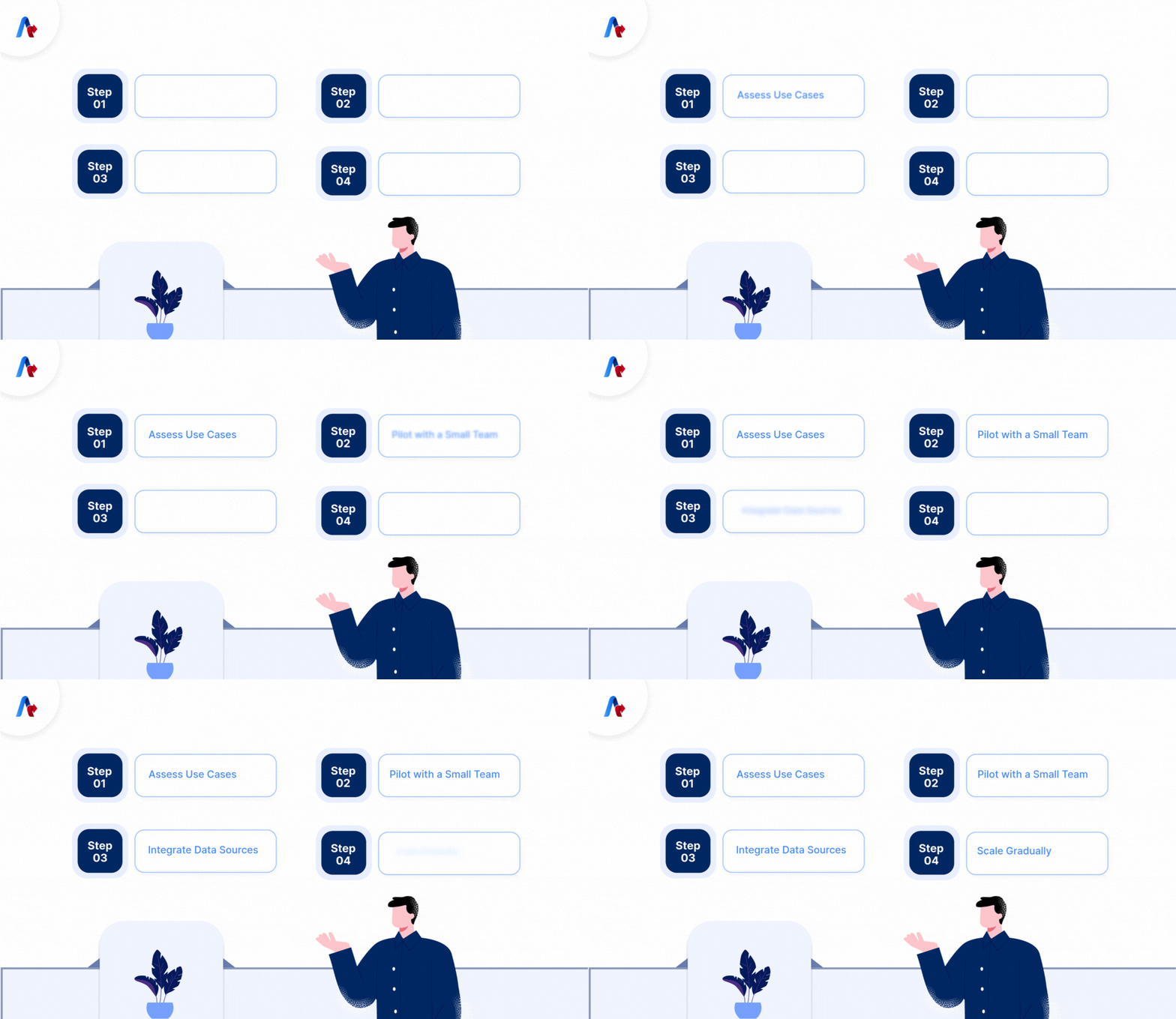
1. Step 1: Assess Use Cases
Identify the highest-value scenarios such as repetitive troubleshooting tasks, documentation bottlenecks, or onboarding challenges.
2. Step 2: Integrate Data Sources
Connect CRM, IoT, ERP, and knowledge bases so agents can access the full context.
3. Step 3: Pilot with a Small Team
Deploy to a select group of technicians, gather feedback, and refine the workflows.
4. Step 4: Scale Gradually
Expand deployment to more teams and include predictive maintenance features.
Field Service in the Age of AI Agents
Agentforce for Field Service is not another software tool; it’s a digital partner in the field. By combining Salesforce’s AI with real-time data and technician workflows, it bridges gaps in knowledge, cuts wasted effort, and enables smarter decision-making on the ground.
In a world where customer expectations are rising and downtime is costly, companies that leverage Agentforce Consulting to equip their technicians with AI-powered agents will see measurable improvements in first-time fix rates, productivity, and customer satisfaction.
Explore how our Salesforce experts can help you implement Agentforce for Field Service
Let’s ConnectFAQs
Utilities, telecom, healthcare, and manufacturing are top adopters due to high variability and critical uptime needs.
By providing dynamic workflow guidance and on-demand answers, it reduces ramp-up time significantly.
Yes. It’s designed to integrate with Salesforce CRM, IoT platforms, and external systems through APIs.
Most companies report 20–30% faster resolution times and reduced documentation overhead within the first year.
No. It acts as a QA testing agent-style co-pilot, handling repetitive tasks while humans focus on complex problem-solving.