


Ask any CTO what keeps them up at night about enterprise AI, and you'll hear some version of the same worry: "What happens when an AI agent gets our numbers wrong, and everyone believes it anyway?"
That fear isn't paranoia. It's math. Large language models are brilliant at language, mediocre at business context. Feed an AI agent for raw database access, and it might miscalculate a churn rate, misread a regional sales KPI, or ignore row-level security entirely. The output sounds confident. It's also wrong. And in a boardroom, confidently wrong is worse than obviously unsure.
This is exactly the gap Tableau MCP was built to close.
What Is Tableau MCP?
Tableau MCP is Tableau's implementation of the Model Context Protocol (MCP) - an open standard that lets AI agents like Claude, ChatGPT, or Gemini securely query governed Tableau data instead of raw databases. It routes every AI request through certified metrics, semantic models, and existing permissions, so answers stay accurate and auditable.
In plain terms: it's the difference between letting an intern loose in your data warehouse versus handing them a well-labeled dashboard your finance team already trusts.
What Is the Model Context Protocol (MCP)?
Before Tableau MCP makes sense, MCP itself needs a quick definition.
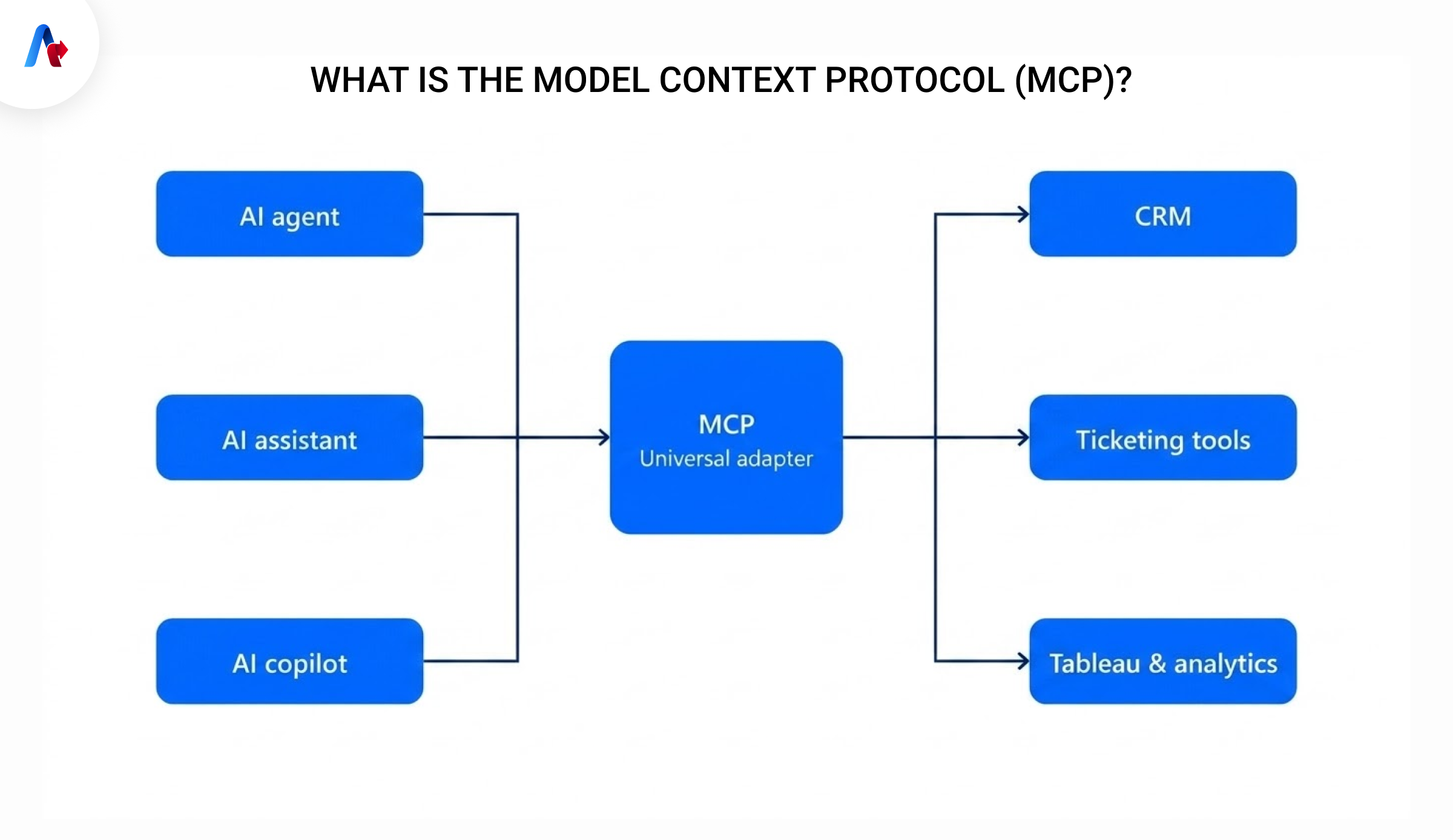
Model Context Protocol (MCP) is an open standard that lets AI models and enterprise applications talk through one consistent interface, instead of custom-building a new integration for every AI tool a company adopts.
Think of MCP as a universal power adapter. Before it existed, every AI assistant needed its own bespoke wiring into every data source brittle, expensive, and a security nightmare to maintain. MCP standardizes that connection once, and every compliant AI agent can plug in the same way.
Anthropic open-sourced the protocol, and it's rapidly become the connective tissue between AI agents and enterprise systems CRMs, ticketing tools, and increasingly, analytics platforms like Tableau.
How the Tableau MCP Server Works
Here's the request-to-response journey, step by step:
- Natural language query: A user asks an AI assistant something like, "Are the states with the highest sales also the most profitable?"
- Context routing: The AI agent routes that request through the Tableau MCP Server, which translates it into a structured query respecting existing data models.
- Governed data retrieval: Tableau applies certified metrics, semantic definitions, row-level security (RLS), and user permissions before pulling any data.
- Trusted response: The verified result flows back through the MCP layer, and the AI agent turns it into a clear, natural-language answer with the numbers to back it up.
No step skips governance. That's the entire point.
Tableau MCP vs. Traditional AI-Database Connections
| Traditional AI | Tableau MCP |
|---|---|
| Connects directly to raw databases | Connects through Tableau's semantic layer |
| Doesn't understand business definitions | Uses certified semantic models |
| May ignore business calculations | Applies certified metrics automatically |
| Needs custom integration per tool | Uses the open MCP standard |
| Security built separately for each AI tool | Inherits Tableau's permissions and RLS |
Ready to Connect AI Agents to Trusted Enterprise Data?
Talk to our AI and analytics expertsTableau Next MCP: Taking It Further
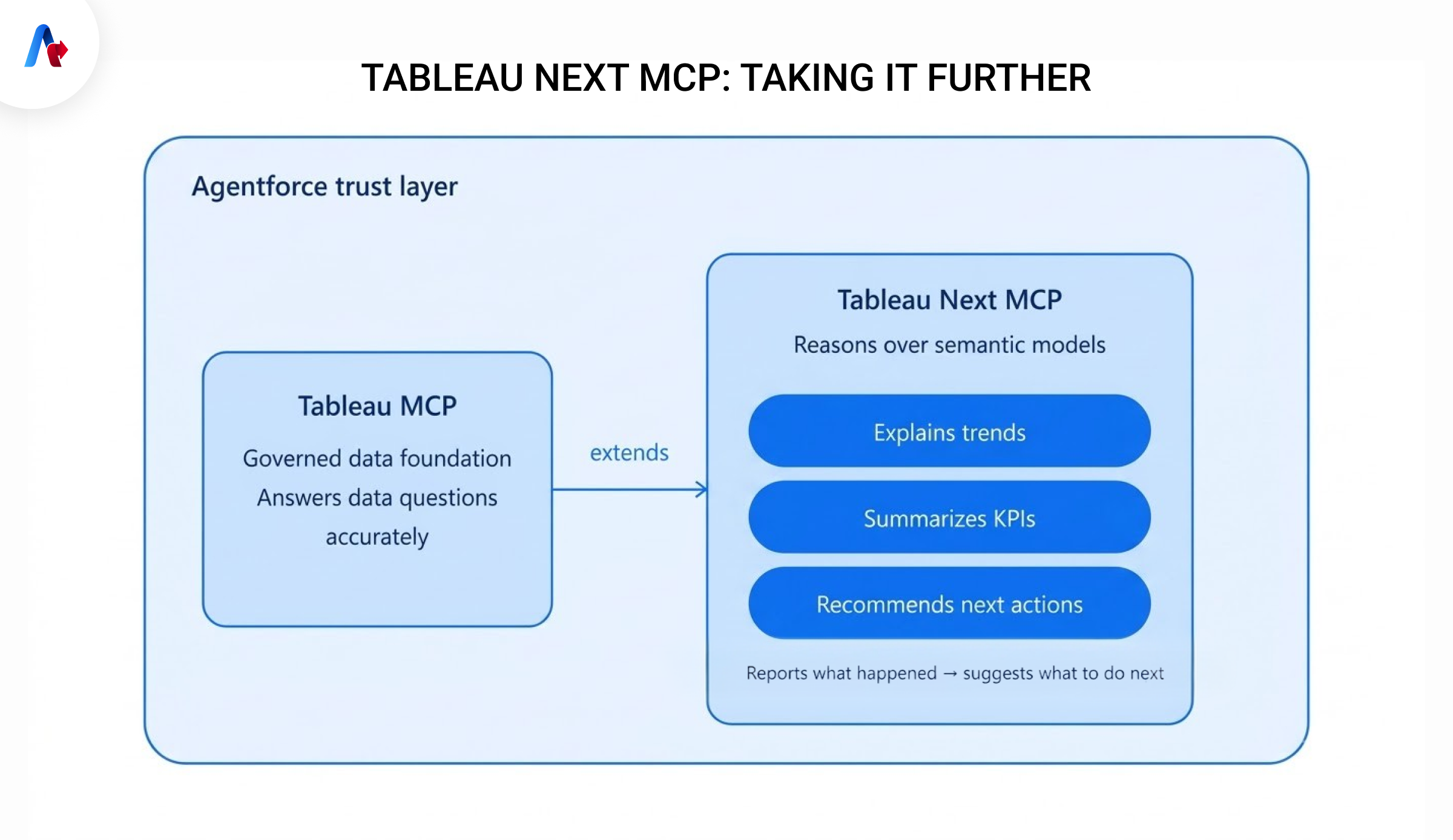
Tableau Next MCP extends Tableau MCP with AI-native, agentic analytics letting AI agents reason over semantic models, explain trends, summarize KPIs, and recommend next actions, all under Salesforce's Agentforce Trust Layer.
Where Tableau MCP focuses on answering data questions accurately, Tableau Next MCP pushes toward agentic analytics: agents that don't just report what happened but suggest what to do next still grounded in the same governed data foundation.
Why Tableau MCP Matters for Enterprise Leaders
According to Salesforce's own analysis of enterprise AI adoption, a growing share of companies already have AI agents live in production, with many more piloting them meaning the governance question isn't theoretical anymore. It's operational today, in real budgets and real decisions.
Without a governance layer like Tableau MCP, AI agents' risk:
- Hallucinating metrics because they don't know your certified KPI definitions
- Ignoring row-level security, exposing data to users who shouldn't see it
- Producing inconsistent answers across teams asking the same question different ways
- Forcing engineering teams into endless one-off integrations for every new AI tool
Tableau MCP solves this by keeping the AI agent's speed while enforcing the enterprise's accountability standards a balance many CTOs describe as "velocity versus trust."
Turn AI Potential into Enterprise-Ready Intelligence
Talk to our AI expertsBusiness Benefits at a Glance
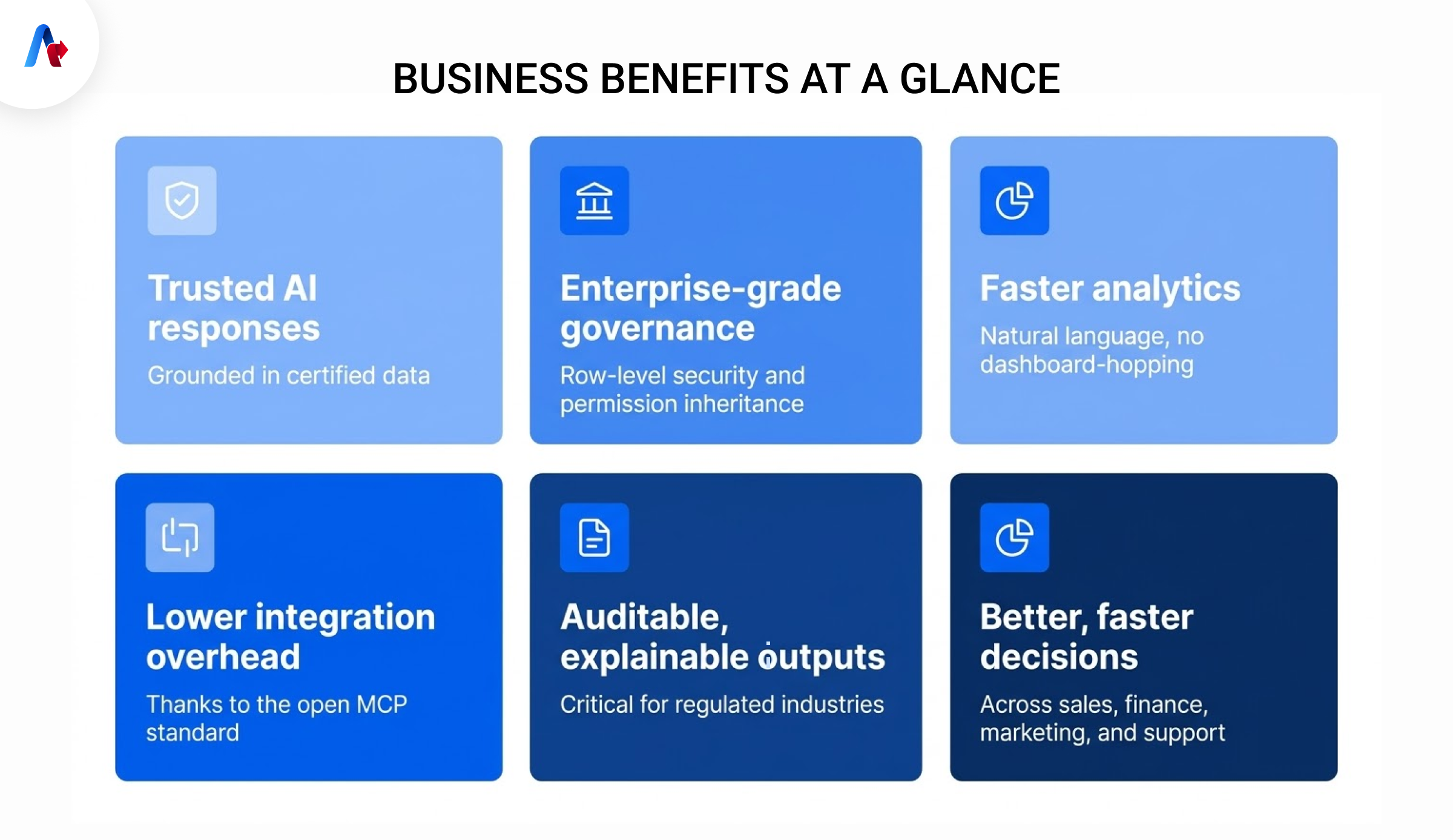
- Trusted AI responses grounded in certified data
- Enterprise-grade governance, including RLS and permission inheritance
- Faster natural language analytics without dashboard-hopping
- Lower integration overhead thanks to the open MCP standard
- Auditable, explainable outputs critical for regulated industries
- Better, faster decisions across sales, finance, marketing, and support
Real-World Use Cases
Sales teams ask AI agents to flag pipeline risk by region instead of waiting on a weekly report.
Marketing leaders get instant campaign ROI breakdowns without pulling a BI analyst off another project.
Finance teams ask an AI agent to explain revenue variance month-over-month, with the certified P&L definitions baked in.
Customer service leaders identify emerging support trends before they become escalations.
Executives receive AI-generated KPI summaries each morning grounded in the same numbers the board sees, not a paraphrased guess.
In BFSI, for example, a Tableau MCP-connected agent can instantly flag branch clusters where unsecured loan growth is outpacing historical default trends a query that used to mean days of waiting on a risk report.
Best Practices for Rolling Out Tableau MCP
- Start with certified data sources only; don't expose experimental or unvetted datasets to AI agents
- Keep your semantic layer accurate and current; AI is only as smart as the definitions behind it
- Enforce row-level security at the Tableau layer, not as an afterthought in the AI tool
- Monitor AI usage and query patterns to catch misuse or drift early
- Regularly validate business definitions as KPIs evolve - stale metrics quietly erode trust
Conclusion
Tableau MCP isn't just another AI integration it's the governance layer that lets enterprises adopt agentic AI without gambling on data trust. Combined with Tableau Next MCP, it gives organizations a path to faster, natural-language analytics that still respects every permission, definition, and metric your teams already rely on.
If your organization is exploring AI agents or copilots, the smartest first move isn't picking a model it's making sure whatever model you pick can only ever see governed, trusted data. Connect with our analytics team to see where it fits into your current stack.
Get expert guidance on connecting Tableau, AI agents, and enterprise systems while maintaining security, governance, and data integrity.
Connect with AccelirateFAQs
Yes. Tableau MCP is built on the open-source Model Context Protocol, and Tableau publishes its MCP server implementation openly, so enterprises can inspect, extend, and integrate it without vendor lock-in.
Tableau MCP works with any MCP-compatible AI agent, including Claude, ChatGPT, Gemini, and custom-built enterprise agents since MCP is a standardized, model-agnostic protocol rather than a proprietary connector.
Tableau MCP answers governed data questions; Tableau Next MCP adds agentic reasoning trend explanation, KPI summarization, and recommended actions while staying inside the same security and governance boundaries.
No. Tableau MCP complements dashboards rather than replacing them. Dashboards remain the system of record for deep visual exploration; MCP simply lets AI agents surface the same trusted numbers conversationally, in the flow of work.
Tableau MCP inherits Tableau's existing permissions and row-level security automatically it doesn't create a separate security model, so an AI agent can never see more than the querying user already could.