



Quick Summary
Accelirate’s Healthcare & Life Sciences (HLS) solutions have introduced Claim Status Follow-Up Automation to address a critical gap in the healthcare claims process. While claims management software has helped many organisations to streamline their claims creation and submission process, it often overlooks the post-submission phase, which still remains manual and fragmented across clearinghouses, EDI responses, and payer portals. Accelirate’s HLS solutions bring continuous monitoring and agentic automation to this phase, helping healthcare organizations track in-flight claims, retrieve payer status updates and claim identifiers, and manage post-submission follow-up with greater consistency and control. With structured follow-up workflow and intelligent orchestration, this solution help to reduce A/R aging, prevent avoidable denials, and gain greater visibility into payer processing across the revenue cycle.
For years, many healthcare leaders believed that investing in claims management software and front-end automation had largely solved the efficiency challenges in claims processing. Claims could be coded, scrubbed, and submitted electronically with far fewer errors than before. On the surface, it looked like the revenue cycle had finally become streamlined.
But today’s environment is revealing a different reality. Payer rules are becoming more complex, claim volumes are increasing, while the status information is spread across multiple systems. Even in highly automated environments, revenue cycle teams still check payer portals, chase claim updates, and manage growing “no response” workqueues manually. The automation that once seemed sufficient often stops right at submission—leaving the most unpredictable phase of the claim lifecycle largely unmanaged.
As these challenges grow, healthcare organizations are realizing that post-submission visibility is just as important as submission accuracy. The approach to automation is also evolving—from manual follow-up and task-based bots to agentic automation that continuously monitors claim activity and interprets payer signals. This shift is becoming critical as payer complexity and claim volumes rise, directly impacting cash flow and A/R aging.
But to understand why this change is necessary, we first need to clearly look at the problem.

Ready to bring intelligence to your post-submission claims process?
Call our expertsWhy Claims Get Stuck in “No Response” Workqueues?
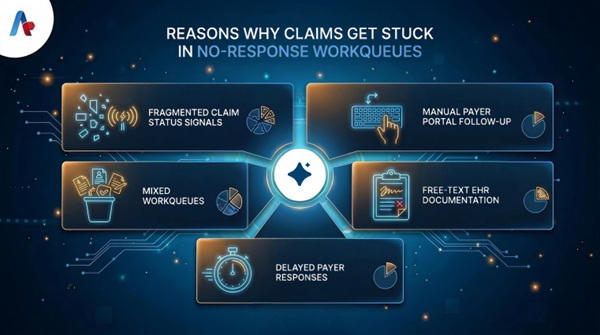
Claims often get stuck in a "no response" workqueues because the post-submission phase lacks visibility and coordination. As status updates are scattered across multiple channels, it gets difficult for teams to determine which claims are progressing normally and which require action.
Because of this unclear prioritization and monitoring process, many claims sit unresolved for extended periods, gradually aging into 60- or 90-day A/R buckets and increasing the risk of delayed payments or avoidable denials. Here are some key reasons that can cause claims to stall:
- Fragmented claim status signals:The follow-up on the claims is delayed because the claim status signals are fragmented and difficult to access.
- Manual payer portal follow-up:Team has to manually log into several payer portals to check claim status and retrieve claim numbers that makes the entire process time-consuming and error-prone
- Mixed workqueues and inconsistent prioritization:Because of a lack of clear prioritization rules, teams often rely on personal judgment rather than financial impact or claim aging.
- Free-text documentation in the EHR: Claim status updates are often written as notes in the EHR, which makes them hard to track, analyze, or report on later.
- Delayed payer responses: Payers can also delay claim processing without giving any clear update, which can be difficult for the team to notice
What is claim status follow-up automation in healthcare?
Claim Status Follow-Up Automation is a post-submission claims automation solution that helps healthcare organizations to automatically track the status of claim after it has been sent to the payer. It continuously monitors in-flight claims, retrieves payer status updates and claim identifiers, and records structured information back into the EHR alongside existing claims management software, instead of relying on staff to manually check updates across multiple systems
It uses agentic automation and AI that automates payer portal follow-up, interprets payer responses, and decides when a claim needs attention. Rather than simple task-based bots, agentic automation continuously monitors claim activity, prioritizes claims based on aging or financial risk, and coordinates follow-up actions across portals, clearinghouses, and EDI signals.
It also helps revenue cycle teams act sooner by timely identifying issues related to pending documentation, coordination-of-benefits conflicts, or coding problems. It gives organizations better visibility and control over submitted claims
How does agentic automation help track healthcare claims after submission?
Let’s take a closer look at how Accelirate’s automation goes beyond simple status checks to manage the entire follow-up process:
1. Centralize in-flight claim signals
The post-submission claims automation system collects claim updates from all channels and s into one place, helping teams to track which claims are still in process and which need follow-up.
2. Prioritize claims by risk and financial impact
The system looks at factors like claim age, claim value, and payer response patterns while prioritizing claims, which helps revenue cycle teams focus on claims that could impact revenue the most.
3. Automate payer portal follow-up
The system can automate payer portal follow-up by retrieving claim status updates automatically, eliminating the need for staff to manually log into multiple portals
4. Write structured documentation to the EHR
Instead of writing manual notes, the system records claim updates in a structured format in the EHR, making it easier for teams to track follow-ups and review claim history.
5. Classify exceptions and route next actions
The system also helps to speed up resolution time by detecting issues like missing documents or coding errors, which are identified and routed to the right team instantly
Still chasing claim updates across portals and systems?
Book a demoWhat is the difference between RPA and agentic automation in healthcare?
So how does our agentic approach improve on traditional automation? The differences become clear when you compare the two:
| Capability | Traditional Automation (RPA Bots) | Claim Status Follow-Up Automation |
|---|---|---|
| Scope | Automates individual tasks such as portal login or data entry | Monitors and manages the entire post-submission claim lifecycle |
| Monitoring | Requires manual tracking between automated steps | Continuously monitors in-flight claims across systems |
| Decision logic | Script-based automation with fixed rules | AI-driven prioritization based on claim age, value, and risk |
| Process awareness | No claim history is maintained. | Maintains claim history and follow-up context |
| Payer interaction | Limited to scripted portal actions | Dynamically retrieves and interprets payer status updates |
| Exception handling | Requires manual routing and intervention | Automatically classifies issues and routes them to the right teams |
| Prioritization | Staff decide which claims to follow up | System prioritizes claims based on aging and financial impact |
| Scalability | Requires payer-specific scripts and maintenance | Works across payers using payer-agnostic orchestration |
| Outcome | Task efficiency improvement | Continuous claim monitoring and proactive follow-up management |
What advantages does claims automation provide for revenue cycle teams?
Our agentic automation for claims not only improves how claims are submitted, but it also creates measurable value for the organization as a whole. The impact can be clearly seen across operations, financial performance, and enterprise visibility in the following ways:
1. Operational Impact
By reducing manual monitoring and standardizing follow-up activities, automation helps revenue cycle teams manage claims more efficiently.
- Reduces the need for manual payer portal checks.
- Standardized follow-up cadence brings consistency across teams.
- Staff spend less time tracking claims and more time resolving issues.
- Prioritizes claims on aging, value, and risk.
2. Financial Impact
Post-submission claims automation helps organizations improve revenue performance by identifying stalled claims earlier and speeding up reimbursements.
- Helps to detect stalled or pending claims earlier.
- Timely follow-ups help to reduce 60- and 90-day A/R aging.
- Early issue detection helps prevent avoidable claim denials.
- Faster claim resolution improves cash flow predictability.
3. Stakeholder Impact
Helping automate payer portal follow-up gives revenue cycle leaders and stakeholders clearer visibility into claim status and follow-up activities.
- Structured claim status records improve reporting and operational insights.
- Revenue cycle leaders gain visibility into payer response patterns and delays.
- Follow-up actions are recorded with audit-ready documentation.
- Leadership can identify bottlenecks and improve revenue cycle decision-making.
What KPIs should revenue cycle leaders track for claims automation?
Healthcare leaders can use these key metrics to measure the impact of automation effectively:
- First status confirmation time: To tracks how quickly the first payer update is received after submission.
- Payer claim number capture rate: To track how many claims have payer claim numbers successfully captured.
- 60–90 day A/R aging reduction: To track the drop in claims aging beyond 60 or 90 days.
- Manual hours saved: To track the reduction in staff time spent on manual follow-up work.
- Denial reduction from early intervention: To track how many claim issues are resolved before turning into denials.
Want to turn stalled claims into faster revenue recovery?
Book a demoThe Next Phase of Healthcare Claims Automation
As claims become more complex, relying only on submission-focused automation is no longer enough to protect revenue. Healthcare organizations need stronger control over the post-submission phase, where delays and missed follow-ups often occur. This gap is addressed by our payer portal follow-up automation, which integrates agentic automation that continuously monitors claims, standardizes follow-ups, and helps organizations reduce A/R aging while improving revenue cycle performance.
Book a demo to see how Accelirate HLS Solution helps to turn your stalled claims into faster revenue