



Quick Summary
Enterprises exploring AI agents often share one concern: Can these agents work with the systems we already depend on? Salesforce Agentforce was purpose-built to answer this question with a “yes.” Its architecture is designed to integrate with CRMs, ERPs, HRMS platforms, and industry-specific systems through the combined strength of the Salesforce Einstein 1 Platform, MuleSoft, and open APIs.
Many organizations are excited about the promise of AI agents but are equally cautious about introducing anything that might disrupt core systems. In conversations with CIOs, CTOs, and operations leaders, one question consistently takes priority, “Can AI agents operate reliably within our existing enterprise systems?”
With Salesforce’s Agentforce platform, the answer is not only positive, it is foundational. Agentforce was developed to work inside the ecosystem businesses already operate, not outside it. Instead of replacing CRMs, ERPs, ticketing platforms, or data sources, Agentforce uses them as the source of truth to act, reason, and perform multi-step operations.
This article offers a clear, in-depth look at how Agentforce integrates with enterprise technology stacks, the business impact it brings, and what leaders should evaluate when adopting it.
Understanding Agentforce: The Backbone of Salesforce’s Agentic AI Model
Before discussing integration, it helps to understand what Agentforce actually does. Agentforce is Salesforce’s next-generation agentic AI platform, introduced as part of its Einstein 1 ecosystem. It enables organizations to build, customize, and deploy AI agents that can perform end-to-end business processes autonomously, whether assisting service reps, handling customer queries, managing internal requests, or even orchestrating data-driven actions across enterprise apps.
Unlike traditional chatbots or static automations, Agentforce agents can reason, plan, and act, making them capable of performing multi-step tasks across business systems while following enterprise policies and logic.
This means enterprises can create digital co-workers that can collaborate with humans and systems alike responding intelligently to customers, retrieving data from CRMs or ERPs, triggering workflows, and escalating to humans when needed.
Why Integration Determines AI Success?

Enterprises rarely operate in a single system. Businesses today run on complex ecosystems like CRMs, ERPs, ticketing systems, HRMS, marketing automation tools, and industry-specific platforms. Any new AI capability must fit into this landscape without breaking it.
Here’s why integration is the most critical success factor for adopting Agentforce:
- Preserve and Extend Existing Investments Enterprises have spent years building digital foundations from Salesforce and SAP to ServiceNow and custom legacy systems. Agentforce improves these investments by plugging into existing APIs and workflows, not replacing them.
- Data-Driven Intelligence AI agents are only as good as the data they use. By integrating with enterprise systems, Agentforce agents can make accurate, context-aware decisions based on real customer, product, and operational data.
- Seamless Operations Instead of creating another siloed platform, integration ensures that Agentforce becomes an extension of your existing processes, such as service case management, lead routing, order handling, or HR requests.
- Governance and Compliance Enterprise systems are built with strict controls, role-based access, and compliance checks. Agentforce inherits and respects these governance models when integrated, ensuring every AI action is traceable and auditable.
- Faster Adoption and ROI Integration minimizes change management overhead. Employees continue to use familiar tools, while Agentforce works quietly in the background to automate and augment.
How Agentforce Integrates with Enterprise Systems?
Salesforce designed Agentforce with enterprise interoperability at its core. Here’s how integration works from a business architecture viewpoint:
1. Built on the Salesforce Einstein 1 Platform
Agentforce runs natively within the Salesforce ecosystem, leveraging its data model, security framework, and workflow engine. That means any enterprise already using Salesforce, whether Sales Cloud, Service Cloud, Health Cloud, or Financial Services Cloud can enable agents without disrupting their current environment.
2. MuleSoft-Powered Connectivity
For enterprises with diverse systems like ERP, HR, legacy mainframes, or data warehouses, MuleSoft acts as the connective tissue. Through MuleSoft APIs, Agentforce agents can:
- Fetch and update data from non-Salesforce systems (like SAP or Oracle).
- Trigger downstream processes such as order updates, policy validations, or claims submissions.
- Maintain real-time synchronization with enterprise data models.
Agentforce doesn’t live in isolation, it lives inside your enterprise fabric, orchestrating work across systems you already own.
3. Open APIs and Extensibility
Agentforce supports secure, API-based integrations, allowing enterprises to connect with external databases, messaging systems, or analytics tools.
- Connect agents with proprietary systems.
- Extend capabilities using partner APIs.
- Maintain control of data flows through API gateways and policies.
Agentforce doesn’t live in isolation, it lives inside your enterprise fabric, orchestrating work across systems you already own.
4. Governance, Security, and Compliance Alignment
Integration doesn’t just mean data flow, it means responsible data access. Agentforce leverages Salesforce’s enterprise-grade governance features:
- Role-based access controls
- Encryption and field-level security
- Complete action traceability
- AI guardrails and audit logs
This ensures that Agentforce agents operate within the same security perimeter as existing systems.
Ready to integrate AI agents into your enterprise?
Start the conversationHow Businesses Apply Agentforce Across Systems?
Let’s look at some realistic examples of how businesses are integrating Agentforce into existing systems:
1. Healthcare: Intelligent Patient Coordination
A healthcare provider uses Salesforce Health Cloud connected with an EHR system through MuleSoft.
- The Agentforce AI agent can check patient eligibility (from payer APIs), schedule appointments, and update clinical notes automatically.
- It doesn’t replace the EHR, it augments it, pulling and pushing data as needed.
- Business Impact: Shorter patient waits times, reduced manual data entry, improved care coordination.
2. Insurance: Claims Pre-Authorization
An insurer uses Salesforce Financial Services Cloud and a core policy admin system (Guidewire).
- The Agentforce agent verifies claim data, checks policy rules, and initiates a pre-authorization request via APIs.
- It then updates the claim record in Salesforce automatically.
- Business Impact: Faster claims cycle, fewer manual approvals, better compliance tracking.
3. Retail: Order Management and Customer Service
A retailer integrates Agentforce with SAP and Commerce Cloud.
- When a customer asks “Where is my order?”, the AI agent retrieves the order status from SAP, updates the Salesforce case, and replies instantly.
- For delayed orders, it can trigger a replacement or refund workflow.
- Business Impact: Improved customer satisfaction, reduced agent workload, proactive service.
What Are the Business Benefits of Integrating Agentforce?
Let’s look at the real value of Agentforce that comes from integration.
| Benefit | Business Impact |
|---|---|
| Operational Efficiency | Automates repetitive tasks and reduces manual workload |
| Cost Optimization | Reuses existing infrastructure — no need to rebuild systems |
| Faster ROI | Quick deployment through pre-integrated Salesforce and MuleSoft stack |
| Improved Decision-Making | Unified access to enterprise data for AI reasoning |
| Enhanced CX and EX | Seamless experiences for both customers and employees |
| Future-Proof Scalability | Easily extend agents across departments or systems |
Agentforce AI Agents Integration Challenges to Consider for Leaders
Even with a strong integration framework, business leaders should be mindful of:
- Legacy complexity: Older systems may lack modern APIs; MuleSoft integration helps bridge this gap.
- Data readiness: Poor-quality data leads to unreliable agent actions, a strong data governance model is key.
- Change management: Employees need training and clarity on how AI agents fit into their workflows.
- Security alignment: AI access policies must be synchronized with enterprise governance.
- Scaling strategy: Start with focused use cases before rolling out across all departments.
A Practical Roadmap for Agentforce AI Agents Integration for Businesses
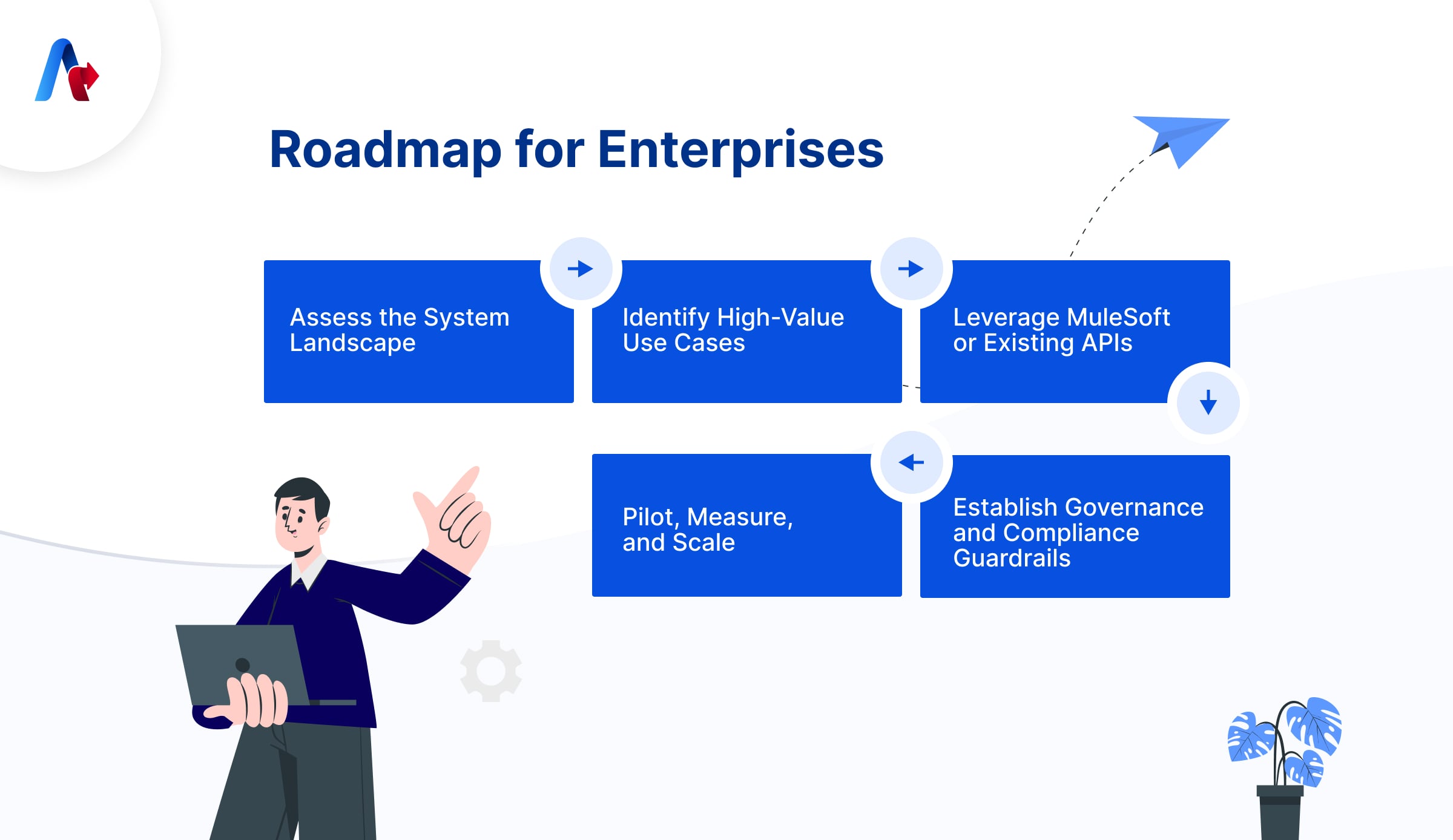
To ensure successful integration, organizations should follow a clear roadmap:
- Assess the System Landscape Map all systems where Agentforce needs to act like CRM, ERP, ticketing, etc.
- Identify High-Value Use Cases Start with areas like customer service, order management, or HR automation where ROI is tangible.
- Leverage MuleSoft or Existing APIs Use integration layers to connect Agentforce with external systems.
- Establish Governance and Compliance Guardrails Define who monitors agent actions, escalation protocols, and audit practices.
- Pilot, Measure, and Scale Begin with a controlled pilot, measure business outcomes, and scale horizontally.
A Connected Enterprise Is Where Agentforce Performs Best
Agentforce represents the next leap in enterprise AI adoption, but, its true power lies in integration, not isolation. Businesses don’t have to rip and replace existing systems. Instead, they can extend them with intelligent, autonomous capabilities that act across CRM, ERP, and industry platforms.
Through the combined strength of Salesforce + MuleSoft + Agentforce, enterprises can build connected, intelligent ecosystems where:
- AI agents automate end-to-end business workflows.
- Data flows securely and accurately across systems.
- Humans focus on higher-value, strategic tasks.
So, yes, Agentforce AI agents can absolutely integrate with existing enterprise systems, and that’s where their true value shines. From a business standpoint, this integration means faster time-to-value through existing system reuse, lower operational risk due to data governance and security alignment, higher ROI because every AI action amplifies the value of your current technology investments.
By strategically embedding Agentforce into your enterprise architecture, you’re not just adopting AI, you’re evolving your business into an intelligent, connected, and adaptive organization.
FAQs
Yes. MuleSoft allows Agentforce to connect with SAP, Oracle, Guidewire, EHR systems, and custom apps.
It follows Salesforce’s security and compliance model, including RBAC, audit logs, and encryption.
No. Agentforce can read and write to external systems through APIs without moving data.
Not necessarily. It complements existing automations by orchestrating actions across systems.
Simple use cases can be integrated in weeks; complex ERP workflows may require phased implementation.