



Quick Summary
Most insurers today use modern tools like OCR, eSign, RPA, and AI to automate their tasks, but still struggle with slow claims, inconsistent workflows, and high manual exceptions, as their processes are not structured for real automation. But insurance process automation solves this problem by using a coordinated mix of RPA, AI, and intelligent orchestration, which creates an end-to-end workflow across claims, underwriting, policy servicing, billing, and finance. Its three-phase implementation approach helps to turn fragmented tasks into scalable operations that gives higher throughput using existing system. This makes managing automation easy and gives competitive advantage.
Insurance leaders are under constant pressure to be faster, more accurate, and deliver better customer experience. They assume to have these things are covered by investing in modern automation tools like OCR, eSign platforms, and RPA bots. Insurers would think all these tools would make their operations run effortlessly, but that’s rarely the case.
As you look closely, you will notice that most of the processes still rely on legacy systems and manual labor. Advanced tools are being used in isolation because of which workflows vary from team to team; exceptions keep growing, and any surge in volume slows everything down. Outdated systems, disconnected teams, and rule-heavy processes make automation hard to scale.
The core here is’nt the wrong tool, but the underlying process that is not built in a structured, standardized way that automation can support. Automation often fails when processes are messy, inconsistent, or overly manual. That is where Insurance process automation makes the difference by creating the structure, flow, and consistency needed for automation to actually work.

Wondering how RPA and AI fit into your current systems?
Book a demoWhat Is Insurance Process Automation?
Insurance process automation is about streamlining the entire insurance process, not just some individual tasks. It covers every part of the workflow like claims, underwriting, policy servicing, billing, finance, and compliance, and connects them using a coordinated mix of RPA, AI, document intelligence, and workflow orchestration. This ensures systems, teams, and data sources work together in a smooth, predictable flow, resulting in faster decisions, fewer errors, and far less manual work.
Key components:
- Robotic Process Automation (RPA): RPA bots helps to automate repetitive tasks that usually require manual labor, like data entry, validation, system updates, and document movement, improving speed and accuracy.
- Artificial Intelligence & Machine Learning: AI improves process efficiency by helping the system to understand documents, predict issues, catch errors, score risks, and make smarter decisions
- Document Intelligence (IDP): IDP reads data from all types of documents, including PDFs, scanned images, emails, or handwritten forms, and extracts data from them. It also validates and cleans data with no human intervention.
- Workflow Orchestration: Workflow orchestration is much like a traffic controller in that it routes tasks, triggers approvals, manages SLAs, and coordinates work across teams for consistent and smooth progression.
- Integrated Systems Architecture: This connects all of the main insurance systems, such as claims platforms, policy admin systems, CRM, billing, and data providers, so that data can flow smoothly and decisions can be made more quickly.
What Are the Key Benefits of Insurance Process Automation?
Here's how insurance leaders are benefiting from automated insurance workflow:
- Faster Claims & Underwriting: AI helps to speed up claims and underwriting decisions by 50-80% which eliminates manual errors and provides real-time updates and routing status
- Fewer Errors & Lower Exception Rates: AI can read, extract, and validate information with almost 98–99% accuracy, which cuts down on exceptions, manual mistakes, and misinterpretation.
- Lower Operating Costs: By automating manual and repetitive tasks, insurers can cut operational costs by up to 20-40% without needing additional staff or system support
- Better compliance and auditability: Insurers can avoid regulatory risks by keeping logs, audit trails, and rule-based checks of every action. This makes every workflow compliant and easy to follow.
- Improved Customer Experience: Automation helps to improve customer experience by speeding up resolution time, providing transparent communication, and reducing manual errors, which creates a smooth customer experience
- Workforce Augmentation & Higher Productivity: As automation takes over repetitive tasks, staff can focus on complex judgment work or customer conversations, which will help to improve their skills, morale, and overall service quality
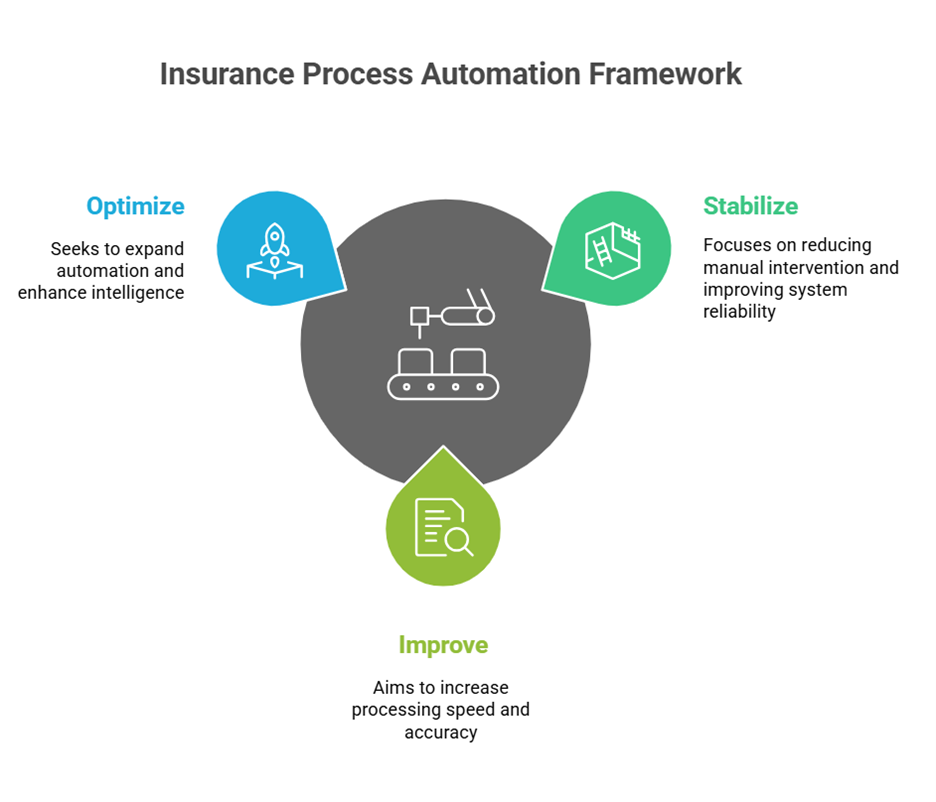
A Three-Phased Framework for Automating Insurance Operations
Let’s understand how a structured three-phase approach turns isolated automation efforts into a reliable, scalable insurance operation:
Phase 1: STABILIZE - Ensuring Consistent Performance
Most insurers deal with slowdowns or spike in manual work because of their inconsistent and unstable system. Which is why the first phase is focused on fixing these issues to make the system more predictable and reliable by strengthening runtimes, standardizing exceptions, and stabilizing integrations which ensures consistent performance throughout the year.
Key Results
- Major reduction in human dependencies and exception variance
- Consistent processing times even during peak periods
- Higher SLA compliance through automated recovery and monitoring
- 99%+ uptime with steady, dependable workflow throughput
Phase 2: IMPROVE - Enhancing Existing Capabilities
Once the operations are stabilised, the next step is to make the existing automation smarter. This phase focuses on strengthening AI/ML models, cleaning up data, and adding intelligent routing, which helps to score risks, spot errors, and improve decision quality. The system is now able to send off cases to the right place automatically with less or zero human intervention, reduces manual review, and improves overall efficiency.
Key Results
- Higher STP rates as more cases flow without human intervention
- Better decision accuracy through cleaner data and improved models
- Fewer exceptions because issues are detected earlier
- Faster turnaround times for both underwriting and claims
Phase 3: OPTIMIZE - Maximizing Value and Competitive Advantage
In the last stage is about taking automation enterprise-wide. Once things are stable and smarter, insurers can expand automation across new product lines, new states, and more teams. It also adds new capabilities like fraud detection, dynamic pricing, and predictive analytics, which helps system to handle higher volume data without extra help and makes overall process much faster and efficient.
Key Results
- 2–4x more processing capacity using the same systems and teams
- Wider automation coverage across personal, commercial, and specialty products
- Measurable profitability gains from better risk, fraud, and pricing intelligence
- Getting a competitive advantage through smarter automation
Having the right framework is only half the story; what really determines success is how well it is implemented, governed, and monitored over time. Accelirate Operations Solution helps to turn this framework to reality by integrating RPA, AI, and orchestration system to ensure that your automation runs reliably, scales effortlessly, and delivers measurable outcomes.
Looking to reduce manual work and speed up decisions?
Call our expertsFrom Tools to True Efficiency
The real value of automation isn’t in the tools themselves but in the flow that connects them. When insurers move from isolated tools to a more structured, end to end automation, they create an operating foundation that speeds decision-making, stabilizes workloads, and supports growth without adding headcount. This helps to make system more compliant, reliable, and reactive. This shift from fragmented automation to a cohesive operating model is ultimately what transforms everyday insurance workflows into a meaningful and lasting competitive advantage.
Ready to transform your automated insurance workflows?
Let’s talkFAQs
Most high-volume, rule-based, and document-heavy workflows can be automated, including FNOL intake, claims processing, underwriting submissions, policy issuance, billing, premium allocation, renewals, endorsements, regulatory reporting, fraud checks, and customer service interactions. With modern AI + RPA, even complex workflows—like risk scoring, document interpretation, and case triage—can be automated end-to-end with humans only handling true exceptions.
In most cases, no. Modern automation platforms (RPA, AI, workflow orchestration) integrate directly with existing PAS, CRM, ERP, billing, and claims systems. The real challenge isn’t outdated systems—it’s unstructured workflows. A structured approach stabilizes what’s already in place and extends automation without expensive rip-and-replace projects.
Foundational automation can be implemented in 4–8 weeks, while broader end-to-end process automation typically spans 3–6 months depending on complexity, data readiness, and cross-system integrations. A phased approach—stabilize → improve → optimize—delivers quick wins early while building toward full-scale modernization.
RPA handles the repetitive, rules-based steps (data entry, system updates, routing), while AI tackles unstructured work like reading documents, interpreting intent, extracting data, and making recommendations. Together, they enable true straight-through processing—RPA executes the actions, AI makes the decisions, and humans intervene only for judgment-based cases.