



 Industries
Accelirate QA Solutions
Industries
Accelirate QA Solutions

As QA leaders, we’re always under pressure to deliver faster, smarter, and more reliable testing agents. With UiPath’s AI Agents ecosystem, there are more powerful options at our fingertips, but selecting the right one is not an easy job.
The main question I face is “Autopilot vs Custom AI Agents: Should I use the first one, a ready-to-use tool that needs little effort, or go for a customized one that can handle complex, large-scale testing?” The truth is that both AI agents have their strengths, but the choice can impact your team’s efficiency, ROI, and long-term scalability.
Autopilot vs Custom AI Agents: Key Differences You Should Know
Before my decision, I tried to understand what each approach could bring to the table. For example, Autopilot is a skilled assistant that can start immediately, while Custom Agents need a specialized team that grows smarter and more capable over time.
- Autopilot: It is a ready-to-use UiPath test automation that simplifies test case generation, refinement, and execution. This AI requires minimal human intervention, so it is perfect for those who need speed and comprehensive coverage.
- Custom Agents: Custom intelligent agents are different from the above because they are tailored to meet specific needs. They can autonomously manage repetitive test activities, adapt to application changes, and scale across large and complex situations. This is perfect for code analysis and creating environments where adaptability is crucial. API test case generation.
Gartner says AI-augmented software testing are tools that use AI to enable continuous, autonomous, and self-optimizing testing across the SDLC from test creation to execution, analysis, and optimization.
Which Tool Works Best at Each Stage of Testing?
Not all testing is equal, and each approach has its advantages. Before selection, it is important to understand how they perform across different testing phases.
Autopilot shines during the early stages of testing, such as test design and execution. It’s perfect for generating large sets of test cases, particularly when you need fast iterations.
For example, if I need to create test cases directly from JIRA user stories, this automation can handle it in minutes. Speed and coverage are the main highlights of this agent.
This is not the case with custom Agents, as they can move them with more complex or code-intensive phases. Understand that these agents can analyze large volumes of code, generate unit tests, and create API-based tests that adapt as the application evolves. It is a perfect choice if you want a resilient and scalable AI for a long-term effort.
Based on my experience, I can say that intention is the key to selection. Use Autopilot to accelerate early-stage testing, and Custom Agents if you want to keep pace with evolving needs.
Choosing Between Speed and Long-Term Value
ROI is the most essential part of automation because it is about impact and sustainability. In my experience, a Test Manager must differentiate between Autopilot and Custom Automation from the perspective of your team and organization.
| Autopilot With Rapid ROI | Custom AI Agents with Long-Term Benefits |
|---|---|
| My experience says that UiPath Autopilot is fit for quicker delivery and cuts time and effort. | Custom AI is difficult as it needs more effort and resources, but delivers long-lasting value. |
| While comparing Ddeclarative Agents vs Custom Agents, this one speeds up tests from days to hours. | Reduce costs by automating repetitive and complex tasks. |
| Reduces manual effort so that QA can focus on higher-value tasks. | Minimize script debt and maintain reliable tests. |
| Improve the delivery of your software application. | It gives self-sustaining test cycles that evolve over time. |
| Provides comprehensive coverage with long-term adaptability. | Provide long-term ROI. |
Are you confused about choosing Autopilot or Custom AI agents? We can help you with that.
Book a free consultation nowHow Do I Make Test Case Management Effortless?
Managing test cases is a challenging task for many people due to several moving parts. But if you have the right tools, you can make it easier. This is what I do.
When I use Autopilot, I can generate and refine test cases straight from requirements faster than before. In one project, we evaluated Autopilot vs Custom AI Agents for generating test cases from JIRA stories. It’s fast, accurate, and saves hours of manual effort.
From my viewpoint, custom automation is perfect for the long-term maintenance phase. Once deployed, these agents update codes and self-heal with minimal human intervention. Here, the manual intervention is less, reduces disruption, and is resilient against frequent application changes.
When to Choose What for Test Automation?
There is always a difference between declarative agents vs custom agents. In the final stage, I ask myself this question: Which one should I pick? The answer is different for every person. This is my recommendation.
- Go with Autopilot when you have priorities on agility and a quick win. It’s perfect for fast test creation or projects where people think more coverage is essential. By choosing this automation, you get immediate results and free up your team for other priority work.
- Custom Agents are my choice for projects where I need compliance, scalability and resilience. If you are analyzing code automatically, create unit tests and create API based tests; these agents can give support, especially when there are frequent changes in the applications.
How We Bring Autopilot and Custom Agents Together
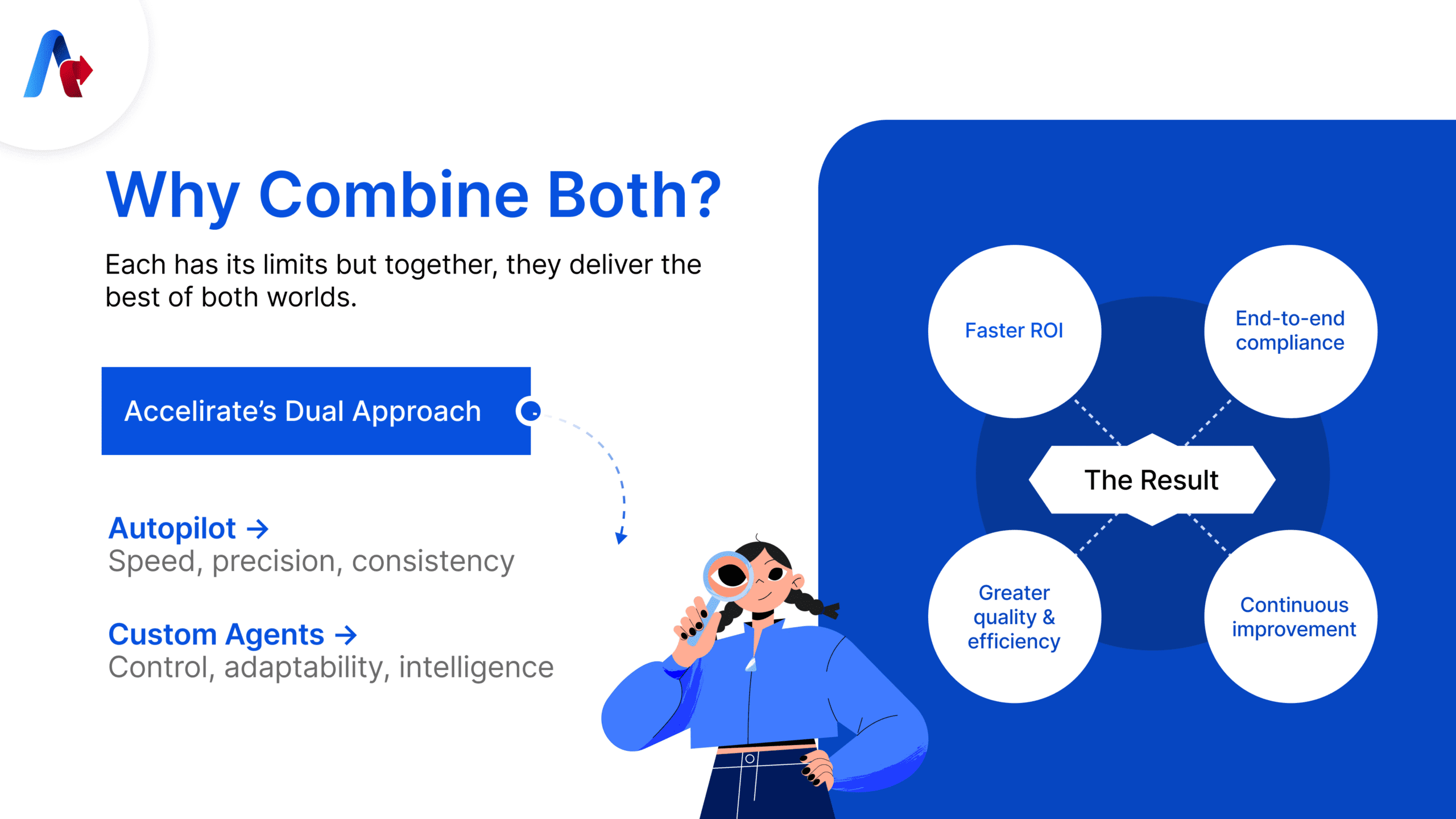
There is always a limitation for each other, which is why I believe combining both can give a good result. As an experienced provider, Accelirate combines both Autopilot and Custom Agents in the testing automation. Now, you get speed and consistency in a single place and achieve better outcomes.
The dual approach in our strategy can give immediate results without compromising the quality of your tool. In other words, I can say that you get faster ROI, compliance, control and adaptability in one place. This is the promise of Accelirate.
Best Practices for Choosing Autopilot vs. Agents
I believe that the success of your automation doesn't come alone by choosing the best tool; it is how you use them strategically. Let me tell you a few of the best practices that you can follow.
- Always choose one that fits the project’s complexity and business importance.
- Pick a tool that has the capacity to integrate with your existing tools for a better outcome.
- Track results and ensure not just speed but also reliability, compliance, accuracy, and outcomes.
- Look for hybrid systems because they can bring speed and accuracy to your automation efforts.
Maximize Your Automation Impact with Perfect Strategy
The final takeaway is that I use Autopilot to accelerate test creation and delivery, while relying on Custom Agents to sustain long-term success. But I really suggest combining both to get immediate results without sacrificing scalability, reliability, or compliance. The smart approach is not only choosing one over the others but combining Autopilot vs Custom AI Agents so that you get what you need.
Treat AI agents like your teammates and test your application with more speed and accuracy.
Talk to our team now
More Articles

Agentic AI in 2026: What Enterprise Leaders Must Prepare for
By 2026, agentic AI will move from pilots to production. Discover what enterprise leaders must prepare for as AI agents reshape business operations.
January 22, 2026

UiPath vs. Open Source: A Test Manager’s Perspective on Choosing the Right Testing Tool
Compare UiPath Test Suite vs open-source tools like Selenium, Rest Assured, and JMeter from a Test Manager’s perspective to choose the right QA and automation stack.
November 18, 2025

Tosca vs. Open Source: A Test Manager’s Perspective on Choosing the Right Testing Tool
Compare Tricentis Tosca with open-source tools like Selenium, Rest Assured, and JMeter. Learn how to choose the right testing tool for scalability, cost, and long-term ROI.
October 21, 2025