


AI Summary
Informatica is an AI-powered cloud data management platform that helps enterprises integrate, clean, govern, and manage data from disconnected systems like Salesforce, SAP, and Oracle. Built around its core platform, Intelligent Data Management Cloud (IDMC), Informatica combines data integration, data quality, governance, and master data management into one AI-driven environment powered by CLAIRE. Widely used for ETL, cloud migration, and enterprise data governance, Informatica supports platforms like AWS, Azure, Snowflake, and Google Cloud, making trustworthy, accurate, and analytics-ready data accessible across the entire organization.
For most enterprises data fragmentation is the everyday reality. Sales data resides on Salesforce; HR information is stored on SAP; financial data is stored in Excel sheets; and your customer support log is managed through another separate software. Data is distributed, inconsistent, and often unusable until someone or something brings it all together.
That is exactly what Informatica does. It has become a highly recognized brand within the space of enterprise data management, and that is for all the right reasons. It is a widely recognized platform in enterprise data management because it helps organizations collect, clean, connect, and govern data across systems.
If you are a data engineer, an IT manager, or even just someone who wants to figure out why "Informatica" keeps coming up in tech conversations at your company, you've come to the right place.
Here, you will learn everything you need to know about the meaning of Informatica, its functions, importance, and role in enterprise data infrastructure today.
What Is Informatica?
Informatica is one of the world’s leading providers of enterprise cloud data management solutions. In essence, Informatica is a highly effective software solution that assists companies in collecting, cleansing, connecting, transforming and managing data from nearly any possible source.
In simple terms, Informatica makes sure your data is accurate, connected, and ready for decision-making. It is not just an ETL tool or a basic data pipeline builder. It is a full-scale AI-powered cloud data management platform built to handle the complexity of modern enterprise data environments with cloud, governance, quality, and MDM capabilities.
Founded in 1993 and headquartered in Redwood City, California, Informatica serves thousands of enterprises across industries including banking, healthcare, retail, and manufacturing.
Need Help Choosing the Right Informatica Solution?
Talk to an Informatica Consultant
What Is Informatica Used For?
Informatica's capabilities extend well beyond moving data from point A to point B. Here is where it shows up most in the real world:
- Data Warehousing: It can be seen picking up the data from disparate operational systems, transforming it and loading it into the data warehouse so that reports and analytics can be run from the data warehouse. The original ETL use case, and very commonly seen today.
- Data Migration: With organizations moving from older on-premise systems, to more modern cloud applications and platforms-perhaps from Oracle, to Snowflake or even AWS, Informatica has been seen managing many of these, reliably and efficiently.
- Data Integration: The ability to connect all siloes of information within a business, such as ERP, CRM, Databases, and SaaS applications together to ensure that all members of the organization are working with the same data-this is also very commonly seen.
- Data Quality and Cleansing: Any of these reports are ultimately presented to someone-and with this, a number of data cleansing operations are typically undertaken by Informatica prior to the data reaching these people such as; the merging of duplicate records, validation and correction of errors and incorrect values within data sets to ensure it is accurate.
- Batch Processing: Processing large batches of data in a scheduled manner (either daily, weekly or monthly without interruption to operational systems).
- Business Intelligence Enablement: By providing cleansed and structured data to tools such as; Tableau and Power BI to enable users to accurately run reports.
Informatica's Core Platform: Intelligent Data Management Cloud (IDMC)
The Intelligent Data Management Cloud (IDMC) is Informatica's flagship, modern offering and the platform that puts it in a class of its own.
In contrast to the existing systems which address one concern at a time, IDMC addresses issues like data integration, data quality, governance, master data management, among others, under one cloud native platform driven by AI.
What makes IDMC stand out:
- AI-powered automation via CLAIRE, Informatica's AI and machine learning engine to automate tasks like data discovery, mapping suggestions, and data quality recommendations.
- Cloud-native architecture enabling smooth operation across major cloud platforms (AWS, Azure, and Google Cloud).
- Unified metadata management for full data lineage and governance
- Pre-built connectors for different enterprise software systems and data sources
The IDMC solution is not an improvement of the existing version of Informatica only. Instead, it marks a paradigm shift in the field of data management as far as companies are concerned.
Key Capabilities of Informatica
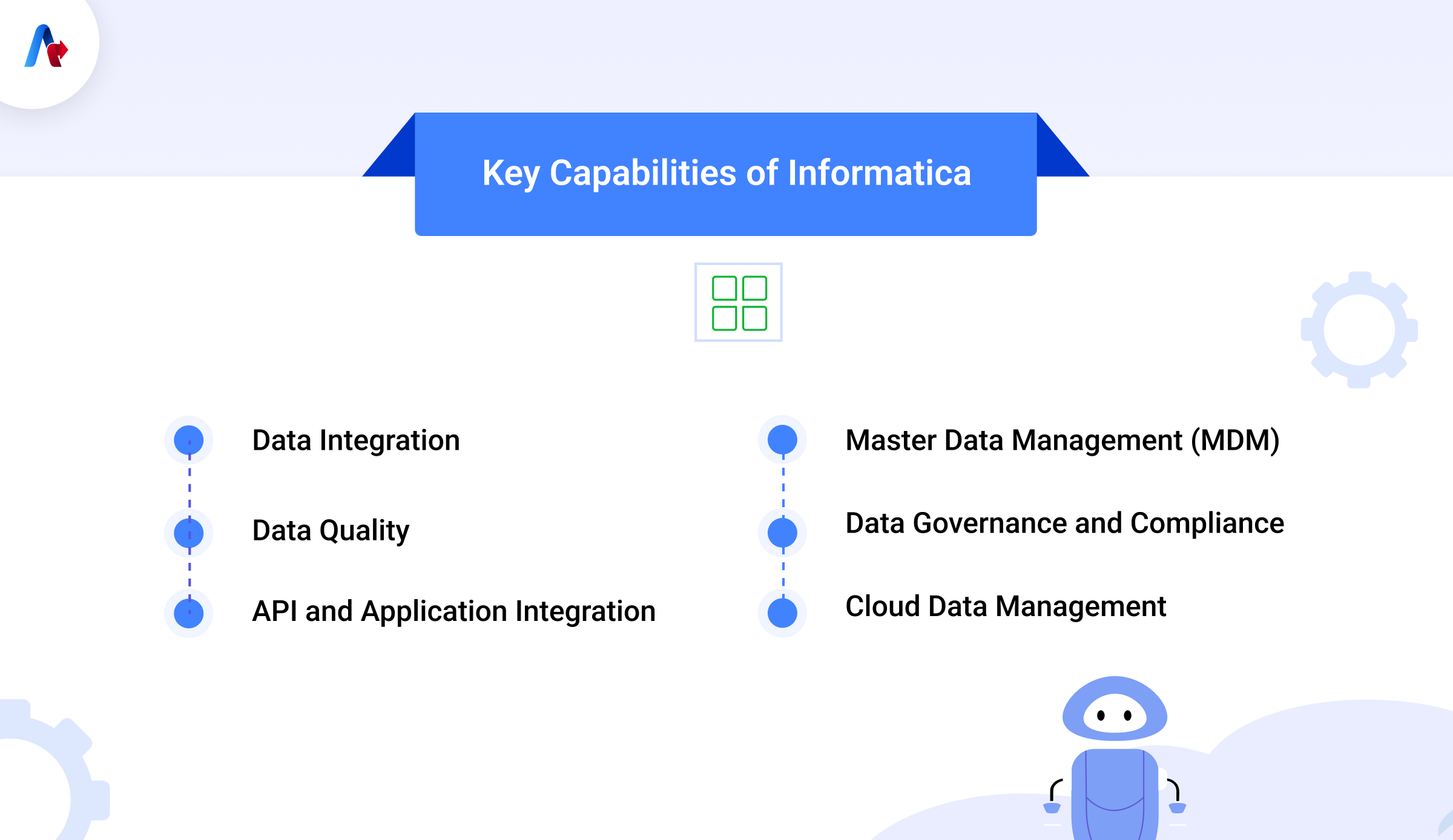
Here is a closer look at the core capabilities that make Informatica the go-to platform for enterprise data teams:
Data Integration
Informatica effortlessly integrates data from diverse sources such as relational databases, flat files, XML, APIs, and cloud applications to the target systems. Informatica can be used to perform both ETL and ELT operations based on architectural considerations.
Data Quality
Informatica data quality solutions help clean the data by eliminating duplicates, standardizing, validating, and enriching them. This ensures that only clean data is fed to business processes and analytics systems.
API and Application Integration
IDMC offers Informatica's API management solution that enables real-time data exchange between cloud-based SaaS and enterprise applications. In many enterprises, this works alongside MuleSoft, where Informatica handles batch and bulk processing while MuleSoft supports real-time APIs.
Master Data Management (MDM)
By integrating Informatica MDM, an organization gets a unified and consolidated view of its key business objects, which include customers, products, and suppliers. This way, users will no longer face issues associated with multiple conflicting versions of data records within different systems.
Data Governance and Compliance
With Informatica, you can trace data lineage (sources and destinations), control who can access the data, and comply with various legal frameworks, including GDPR. All regulated businesses simply have no choice but use such features.
Cloud Data Management
Informatica supports cloud migration and transformation across environments such as AWS, Azure, Snowflake, and Google Cloud. It is designed for hybrid and multi-cloud enterprises.
How Informatica Supports Data Integration and Cloud Data Management
Data integration and cloud data management are not just features of Informatica. They are the foundation of everything the platform does.
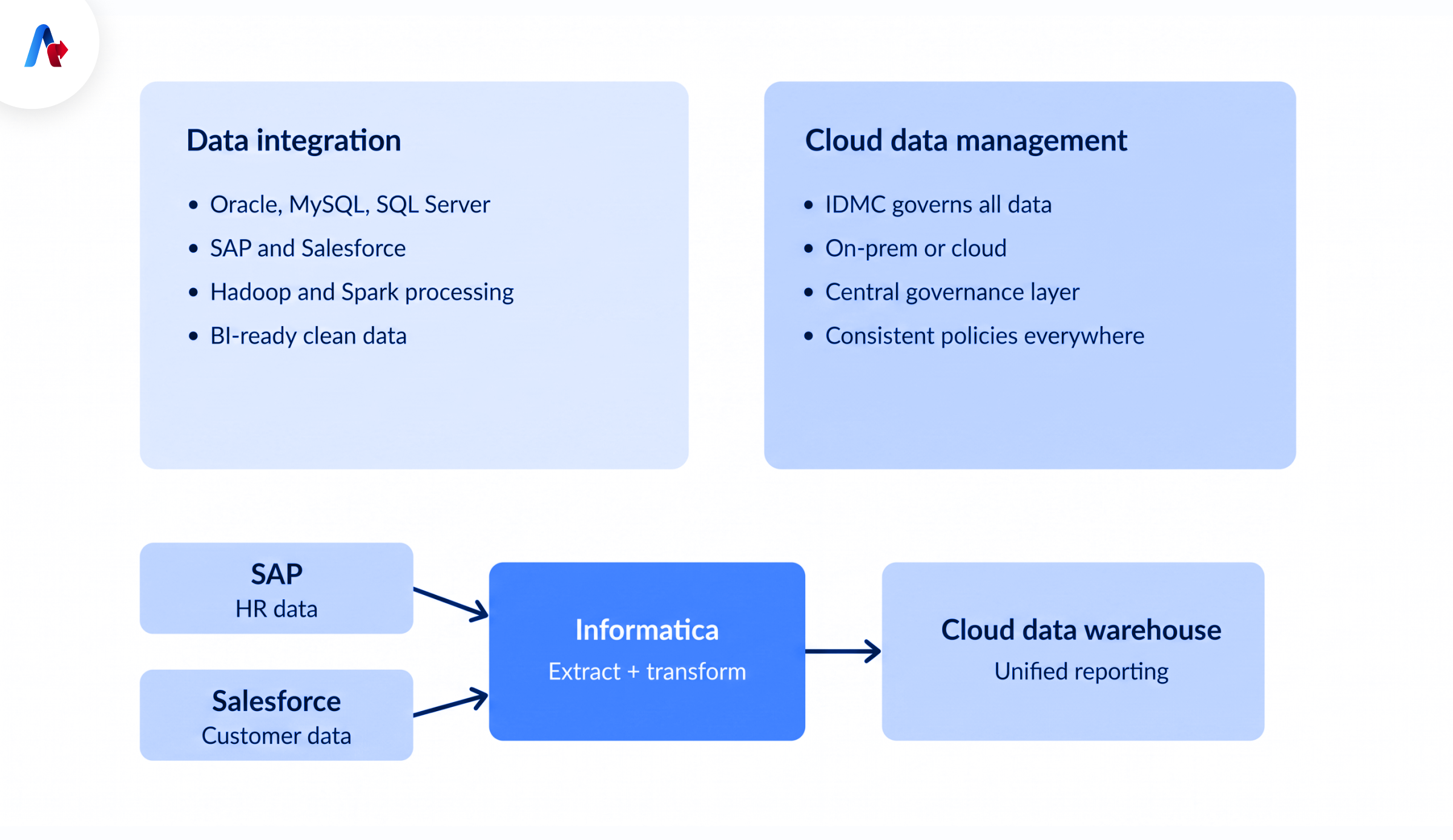
On the data integration side: Informatica integrates the entire range of enterprise applications. It supports databases including Oracle, MySQL, and SQL Server. It is compatible with ERP and CRM systems such as SAP and Salesforce. Structured and unstructured data can be processed using advanced technologies like Hadoop and Spark. It provides business users with integrated and clean data that can be used for analysis by utilizing different business intelligence platforms.
On the cloud data management side: The IDMC from Informatica enables companies to handle their data irrespective of its location - it could be stored either in on-premise solutions or cloud computing systems or a combination of the two. This tool provides a central control layer to govern the data in any environment it may be residing.
A real-life application: A firm operating SAP to manage its HR-related data and Salesforce to collect data about its customers can leverage Informatica to extract information from those systems in batches, match employee IDs, compute necessary metrics, and move all data into a cloud data warehouse for comprehensive reporting.
This set of powerful features allows companies to effectively manage any kind of large-scale data environments.
Still Managing Data Across Multiple Systems?
Schedule a Free Data Integration Assessment
Why Informatica Is Important in Modern Enterprises
We live in a world where data-driven decisions are not optional. But data is only as valuable as its quality, accessibility, and reliability.
Here is why enterprise leaders continue to invest in Informatica:
- Scalability without compromise: Informatica handles petabytes of data with parallel processing and high availability, making it suitable for the most demanding enterprise workloads.
- Reusable components: Mappings, workflows, and transformations can be reused across projects, significantly reducing development time and effort.
- Robust error handling: Detailed logging, error tracking, and recovery mechanisms minimize pipeline failures and make troubleshooting faster.
- Automation-ready: Built-in scheduling and monitoring enable fully automated data workflows with minimal manual intervention.
- Governance built in: Data lineage and impact analysis support compliance and auditability from day one, which is critical for regulated industries.
- Ecosystem compatibility: Informatica works alongside the tools enterprises already use, from Snowflake and Tableau to SAP, Salesforce, and MuleSoft. That makes it a practical choice for organizations that need trusted data across multiple platforms.
In short, Informatica does not just move data. It makes data trustworthy, governable, and actionable at enterprise scale, which is precisely what modern organizations need to compete.
Transform Enterprise Data into Business Value with Accelirate
Accelirate helps enterprises design, implement, and optimize Informatica solutions across the full delivery lifecycle. Our Informatica consulting services are built to support organizations that need strong data integration, cloud modernization, governance, and operational support.
Informatica services include:
- Informatica consulting and advisory.
- Informatica implementation and support.
- ETL and data integration services.
- Cloud migration and modernization.
- Data quality and governance setup.
- Master data management solutions.
- Managed services and ongoing optimization.
Conclusion
Informatica has spent over three decades solving one of enterprise IT's most persistent challenges: making data from dozens of disconnected systems reliable, clean, and useful.
Whether it is migrating a legacy data warehouse to Snowflake, building a unified customer view from Salesforce and SAP, or automating nightly data pipelines for executive dashboards, Informatica is the platform organizations trust to do it right.
If your organization is exploring Informatica implementation, cloud data migration, or data quality improvements, having the right implementation partner makes all the difference between a project that stalls and one that delivers.
Accelirate helps enterprises design, implement, and optimize Informatica solutions across the full delivery lifecycle. From architecture planning and tool selection to managed services and ongoing support, our team brings the technical depth and real-world experience to get your data working the way it should.
Ready to unlock the full value of your enterprise data?
Connect with Accelirate's data integration team and explore how Informatica can work for your business.FAQs
Informatica is an enterprise data management platform, which supports businesses in extracting, cleansing, integrating and governing data coming from several sources. It is particularly known for its ETL capabilities and the cloud platform (IDMC – Intelligent Data Management Cloud) which leverages AI in the management of data at large scale.
ETL stands for Extract, Transform, Load, is the mechanism for pulling data from source systems, converting it into usable data, then loading it into the destination (data warehouse for example). Informatica PowerCenter is one of the leading ETL tool in the enterprise IT world.
Informatica deals with bulk data processing and batch migration of data for warehousing and reporting purposes. MuleSoft, conversely, deals with real-time API integration and allows the connection of systems in order to process instant data flow. In most enterprise contexts, these two platforms coexist; MuleSoft handles the real-time API integration and Informatica handles bulk data processing pipelines for analysis purposes.
IDMC or Intelligent Data Management Cloud, is the core cloud platform of Informatica which unites data integration, data quality, governance, MDM and API management in an AI driven, singular environment, removing the need for multiple disconnected applications.
Yes. Informatica supports cloud and hybrid environments and works with platforms such as AWS, Azure, Google Cloud, and Snowflake.
Informatica was originally built for large enterprise deployments, but its modular cloud offerings have made it more accessible to mid-market organizations as well.
Primary Keywords: What is Informatica, AI-powered cloud data management, data management tools, data management software, cloud data management
Secondary Keywords: ETL Extract Transform Load, API integration, data management, What can Informatica do, Informatica IDMC, Intelligent Data Management Cloud, data integration, data quality, API management