INDUSTRY: IT

How an Internal MuleSoft Team Cut MuleSoft Delivery Time by 52% with Accelirate’s FlowAgent

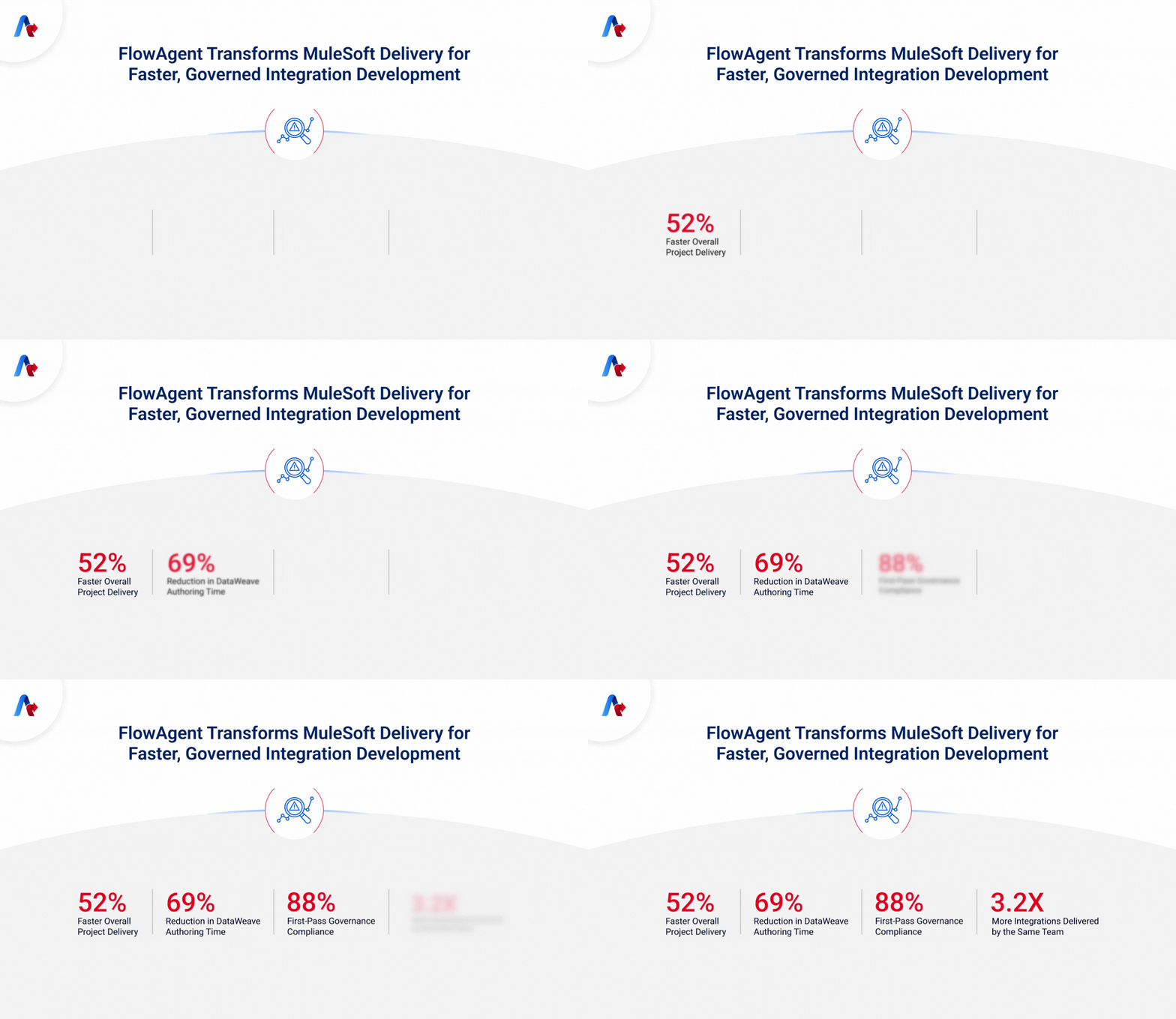
52%

faster overall MuleSoft project delivery

69%

reduction in DataWeave authoring time

88%

first-pass governance compliance

3.2X

more integrations delivered by the same team

53%

reduction in post-deployment defects

Client Overview

The client is an internal MuleSoft team that supports enterprise integration projects across healthcare, retail, financial services, and manufacturing. While the team had strong MuleSoft expertise, senior developers were spending 40–50% of their time on repeatable tasks like RAML drafting, DataWeave mapping, and Mule flow setup. Governance reviews and rework further slowed delivery. The team needed a faster, standards-driven way to scale MuleSoft execution without compromising quality, compliance, or developer productivity.

Key Takeaways

  • FlowAgent reduced repeatable MuleSoft development work across RAML, DataWeave, and Mule flows.
  • Built-in governance rules helped developers create cleaner, review-ready artifacts.
  • Reusable templates improved consistency across client integration projects.
  • Senior developers gained more time for architecture, design, and client advisory work.
  • The internal rollout proved FlowAgent could scale delivery without adding team capacity.
As integration demands grow, MuleSoft teams need a faster way to deliver reliable APIs, transformations, and flows without slowing down governance. But the internal MuleSoft team was spending too much time on repeatable development work, with RAML drafting, DataWeave mapping, Mule flow setup, and review cycles creating delays across active client engagements.
Accelirate’s FlowAgent was deployed to change that delivery model. By connecting MuleSoft-specific development patterns, reusable templates, and governance standards directly inside the developer workflow, the solution helped the team accelerate execution, improve first-pass compliance, and reduce rework while giving senior developers more time to focus on architecture, design, and client advisory.

Accelerating MuleSoft Delivery through AI-Assisted Development and Built-In Governance

MuleSoft delivery often slows down when developers have to recreate the same foundation work across every project. The internal MuleSoft team faced delays across RAML drafting, DataWeave mapping, Mule flow scaffolding, and governance review cycles. While the team had strong technical expertise, too much senior developer time was being spent on repeatable work instead of architecture, design, and client advisory.
To solve this, FlowAgent was deployed as a VS Code extension across the internal MuleSoft practice. The solution connected developers to MuleSoft-specific templates, reusable integration patterns, DataWeave logic, RAML standards, and governance rules directly inside their development workflow. This helped the team generate cleaner artifacts faster, reduce rework, and improve delivery consistency across active engagements.
FlowAgent for MuleSoft Key Pointers:

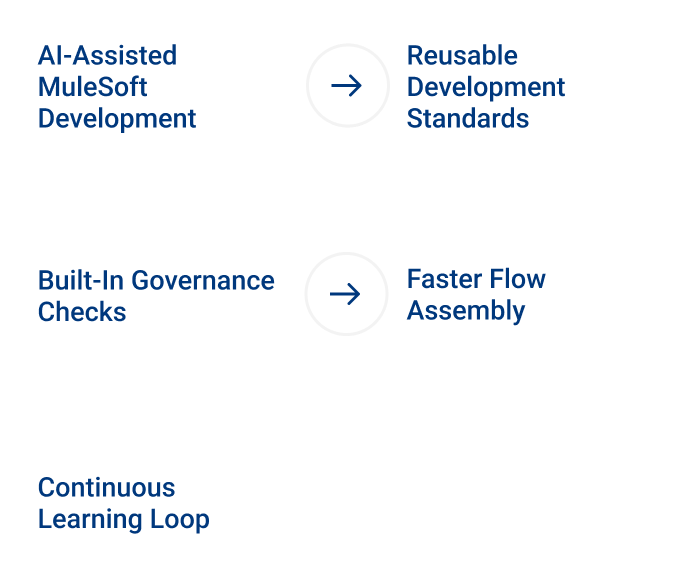
01 - AI-Assisted MuleSoft Development

FlowAgent helped developers generate RAML specifications, DataWeave transformations, and Mule flows faster using MuleSoft-specific patterns.

02 - Reusable Development Standards

A centralized knowledge base gave teams access to approved templates, transformation logic, logging patterns, and error-handling structures.

03 - Built-In Governance Checks

Governance rules were applied during artifact generation, helping developers create review-ready outputs from the start.

04 - Faster Flow Assembly

Standard Mule flow scaffolding reduced repetitive setup work and helped teams move faster from design to delivery.

05 - Continuous Learning Loop

Developer edits were tracked and fed back into the knowledge base, improving future accuracy and consistency over time.


What Was Unique About the Solution That Was Implemented?

Unlike generic AI tools, FlowAgent was built around MuleSoft-specific standards, reusable templates, and approved governance rules. It helped developers generate cleaner RAML specs, DataWeave mappings, and Mule flows directly inside VS Code. This made delivery faster, reduced rework, and kept quality consistent across multiple active engagements.

Turning Repeatable MuleSoft Work into Faster, Governed Integration Delivery

With FlowAgent embedded into the MuleSoft development workflow, the internal MuleSoft team moved from manual, repetitive delivery to a faster and more consistent execution model. Developers spent less time recreating RAML specs, DataWeave mappings, and Mule flows, while governance-ready patterns helped reduce review delays and rework.
Key outcomes included:

01 - Faster Delivery

52% faster overall project delivery across 8 active MuleSoft engagements.

02 - Higher Developer Productivity

69% reduction in DataWeave authoring time, giving developers more time for high-value work.

03 - Better Governance

88% first-pass governance compliance through built-in standards and review-ready outputs.

04 - Reduced Defects

53% reduction in post-deployment defects through reusable patterns and stronger error handling.

05 - Scalable Output

3.2X more integrations delivered by the same team without adding headcount.

Future-Proofing MuleSoft Delivery with FlowAgent

FlowAgent helped the internal MuleSoft team move from repetitive manual work to faster, more governed delivery. With reusable patterns, MuleSoft-specific standards, and AI-assisted development built into the workflow, the team improved speed, quality, and scalability across active engagements. If you’re looking to accelerate MuleSoft delivery without compromising governance, Accelirate can help.

Need a Quick Reference?

Download the mini version of our case study for easy sharing with your team.

Ask Acceliagent