



Quick Summary
A company should ask 10 questions before integrating AI agents with legacy systems. It includes API or RPA connectivity, system rebuilding, RPA bot continuity, vendor experience, timelines, data readiness, human intervention, workflow reusability, POC availability, and security compliance. According to Accelirate's experience across 100+ enterprise integrations, only a few companies had proper audit and compliance plans before selecting a vendor. Once you get clear answers to these questions, it integrates smoothly and avoids costly mistakes from day one.
The 10 most critical questions to ask before integrating AI agents with legacy systems are: API vs RPA connectivity, system rebuild scope, RPA bot continuity, vendor legacy experience, realistic timelines, data readiness, human oversight levels, workflow reusability, POC availability, and security compliance.
Every enterprise is moving fast with automation today. Teams are automating workflows and making decisions in real time, and AI agents are becoming the center of enterprise automation. But there are always challenges with legacy systems because of old ERPs, mainframes, scattered databases and critical business operations. They work but are not flexible. And when a software team tries to plug AI into them without proper planning, things break.
According to McKinsey & Company, 70% of AI efforts fail to deliver value due to integration complexity, poor data readiness, and system limitations. From Accelirate's experience with 100+ enterprise integration support, we found three simple issues: no proper API access to the old system, poor data, and unclear human oversight. A team that can solve them will mitigate the failure risk of integration.
This blog is going to help you avoid that with a 10-step pre-integration checklist, so you can integrate AI with legacy systems and avoid costly mistakes.
Why AI Agents Enterprise Integrations with Legacy Systems Fail and What Causes the Most Project Delays?
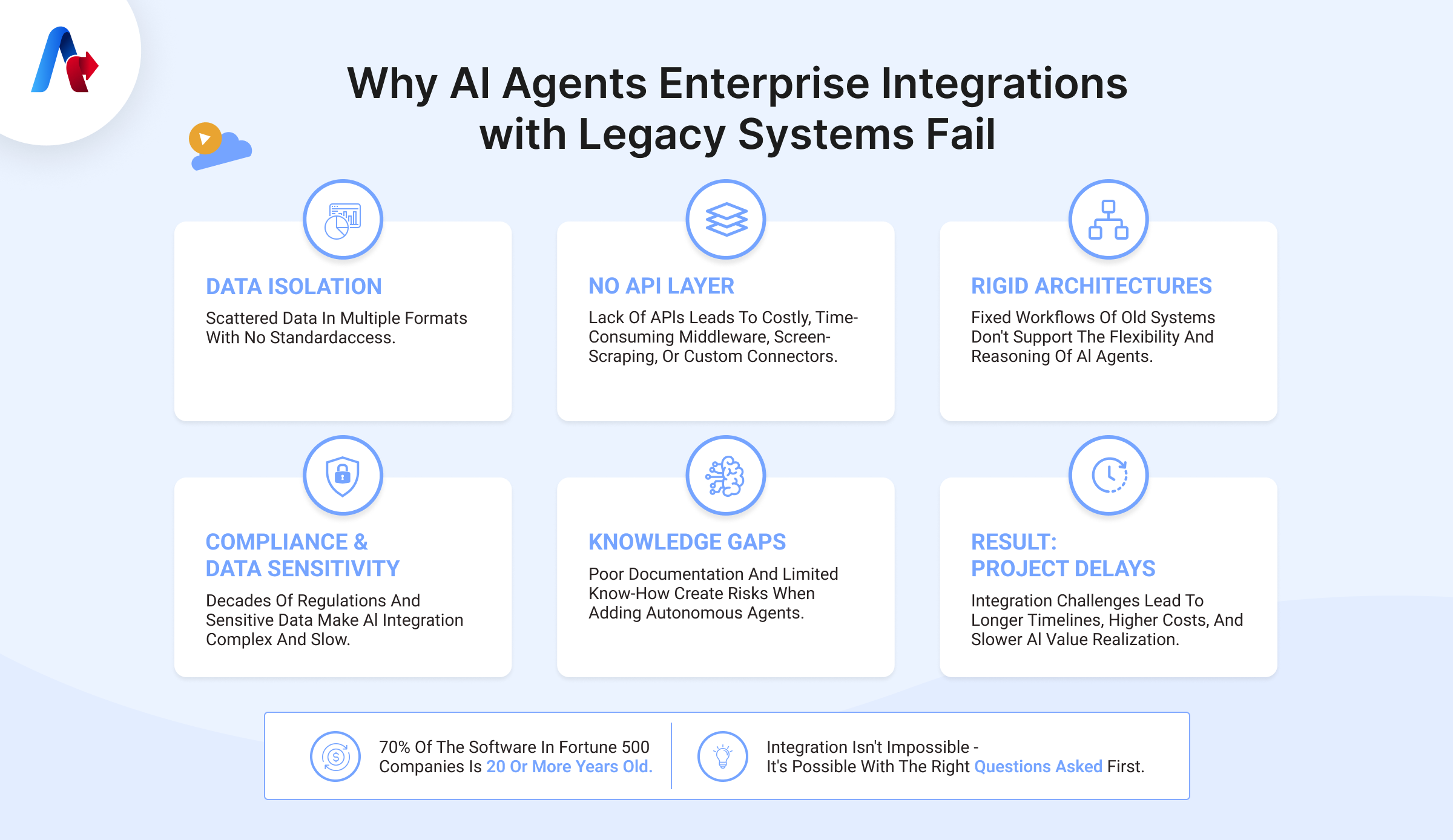
AI automation services promise speed and intelligence, but when it comes to integrating AI agents with legacy systems, organizations face many challenges. It is challenging because of compliance issues, data is hard to use, no API layer, there is a knowledge gap, and it is not built for AI decision-making and flexibility.
- Data Isolation: Legacy automation like RPA mostly stores data in different formats with no standard way to pull it out and use it. With this scattered data, AI agents' integration with legacy systems cannot work and offer reliable and accurate answers.
- No API Layer: Talking to each system is possible with APIs today, but many older technologies don't have them. That means integration requires building middleware, screen-scraping bridges, or custom connectors. They are costly, time-consuming and need more effort.
- Rigid Architectures: Old platforms are built around fixed workflows, but the design of AI agents is flexible. If you want to build adaptability and reasoning, it requires careful agentic orchestration and a plugin.
- Compliance and Data Sensitivity: Industries like healthcare, banking, insurance, and manufacturing may run on legacy infrastructure. It means there are lots of problems and decades of compliance requirements. Any AI integration with those takes time and more effort.
- Knowledge Gaps: Many legacy systems have no proper documentation. Nobody fully knows how these systems behave under unusual conditions, so there are risks when you add autonomous agents to this system.
McKinsey research shows that 70% of the software in the Fortune 500 companies is 20 or more years old.. Accelirate's integration teams encounter this type of issue regularly in various sectors, especially in finance and insurance. It means that there are real challenges in integrating them with modern technology. It doesn't mean that integration is impossible, but it can be when followed by the right questions before you start.
10 Questions to Ask Before Integrating AI Agents with Legacy Systems
AI agents' enterprise integration with traditional systems is a possible action, but you need to ask the right questions. Those questions are built to create clarity on integration, data, and workflows. By answering these questions, an organization can avoid difficulties and save its time and money.
Question 1: How Will AI Agents Integrate with Our Existing Systems—APIs, RPA, or Both?
This is the first question a team needs to ask while going for AI agents integration with a legacy system. The answer will tell you a lot about whether your vendor understands your environment.
There are three primary ways AI agents connect to older systems:
- APIs: Connect directly to systems that have a modern interface. It is a faster, cleaner, and more reliable option available.
- RPA (Robotic Process Automation): Here, software robots that interact with systems at the UI layer and mimic how a human would click and navigate. It is fit for when no API exists.
- Hybrid Approaches: This is the combination of the first two, where we have complex environments with a mix of old and new systems.
An organization can take what is fit to the scenario but ensure that its vendor has a clear and specific plan for its systems. Ask them, do I need APIs to integrate AI agents with existing systems? and what connection method you would use, and why? The answer will tell you whether you must move with the vendor or not.
Question 2: Will We Need to Replace or Rebuild Any Part of Our Current Systems?
A well-designed AI agent integration must work with your existing systems. In short, in most cases, no, but there are some scenarios where you need to change completely for the integration. This situation is because the legacy system will be so outdated that even RPA can't interface with it reliably.
There are other reasons too, like data sources have no export quality. In such situations, an enterprise can go for partial modernization before AI agents' integration with the legacy system.
What you want to understand here
- What exactly would need to change
- Why does it need to change
- What the cost and timeline of that change look like
Question 3: What Happens to Existing RPA Bots After AI Agent Integration?
RPA bots don’t disappear because they are good at running repetitive, rule-based tasks, but AI agents handle decision-making where reasoning is essential. In most cases, companies can use bots rather than being completely replaced.
The smart approach is to keep your existing RPA bots running and layer AI agents on top of them. Let the bots handle what they're already good at, and agents step in where the old system has its limitations.
If your vendor tells you to throw everything out, that is not a good approach because it costs you a lot of money. At this stage, you can also ask some sub-questions, such as:
Ask specifically:
- Can AI agents work alongside our existing bots?
- Can agents trigger and coordinate RPA workflows, or will we need to rebuild them?
Essential read: Migrating from Legacy RPA to UiPath + AI Agents: What to Expect
Question 4: What Specific Legacy Systems Have You Already Integrated AI Agents With?
This is the proof question that you need to ask vendors. And it's one of the most important ones on this list because they love to talk about what their technology can do. What is important is that their experience in the integration is essentially similar to your environment.
Listen for some of the terms like SAP, Salesforce, and legacy mainframe in their talk. Also, look for industries like yours, such as banking, healthcare, insurance and manufacturing. You can also look for complexity like yours (multi-system environments, compliance requirements, high transaction volumes).
If a vendor has experience integrating AI agents with legacy systems for a 30-year-old mainframe for a financial services company, that's meaningful experience you need to consider. If they say they have only limited implementation experience, that's a different conversation.
Ask for case studies from the vendor you think fits. Ask to speak with reference customers whom they have already worked with. Get deep answers about the challenges they hit and how they resolved them. The answers will tell you more than any demo.
Question 5: How Long Does a Typical Integration Take for Systems Like Ours?
In any AI agent implementation enterprise strategy, timeline is the most important and a common friction. Sometimes, the vendors you approach may oversell speed.
The answer depends on several factors:
- How many systems need to be connected
- Whether APIs exist or RPA bridges need to be built
- The quality and consistency of your data
- Your internal IT team's bandwidth and availability
- Compliance and security review processes
For example, while integrating AI agents with legacy systems, like connecting them to an ERP, a CRM, and a document management system, can take time from 8 to 20 weeks.
Everything has its own time, so be cautious of vendors who promise short timelines without analyzing your environment. At the same time, enterprises also need to be very careful of those who say that they can't give you any realistic time and budget at all.
To check this, ask: "Based on what you know about our systems, what's your realistic estimate and timeline you expect for this project? The answer from the vendor can tell the reality, and based on that, you can make a good decision.
Not sure how long your integration will take? The Accelirate team can assess your environment and give you a timeline for your project.
Get a realistic estimate for your systems.Question 6: What Happens If Our Data is Incomplete, Inconsistent, or Spread Across Systems?
This is the question most companies ignore, but one of the most important ones in this category. The data is the backbone of AI agents' enterprise integration. If your ERP has fields that nobody has filled in for years or if your data has never been standardized, this AI automation project will struggle.
Garbage in, garbage out is especially true for agentic AI . An agent tasked with routing a customer request needs accurate and reliable data, and AI that has the task of summarizing a financial report needs consistent and complete records. When the data is messy, there is a problem with bad output and sometimes, agents continuously escalate to the human agents.
The questions to clarify are:
- What data quality standards do we need to meet before deployment?
- Do you offer data cleansing and normalization as part of the implementation?
- How do your agents handle exceptions when data is missing or contradictory?
The best process addresses data quality before, not after implementation. If your vendor doesn't answer these questions, it is good to look for another experienced partner.
Question 7: What Level of Human Oversight is Required While Integrating AI Agents With Legacy Systems?
We can say this as a 90:10 proportion. It means 90% of the work goes to automation, but 10% is essential with the human evaluation. After AI Agents integration, most believe that everything becomes autonomous, but giving 100% to AI is not a good idea, as it can still make errors in the output.
Good AI agent implementations come with human oversight from the beginning onwards. Initially, intelligent agents can do actions like recommending actions, but humans confirm them. After validating the result, an enterprise can reduce the level of human oversight to 10%.
At Accelirate, we follow a five-pillar model AI Governance Framework, including authorization, audit, data boundary, escalation, and drift Detection. For legacy integrations, the two pillars, such as escalation and audit, are integrated before any agent comes into production.
Question 8: Can AI Agents Reuse Our Existing Automation Workflows?
Yes, in most cases, we can use existing automation like RPA bots, workflow tools, and scripted processes. Agentic AI and automation designs can recall existing RPA workflows, trigger automation, and handle judgment calls that were not possible with old automation.
Ask vendors whether they can build on your present system, or whether integration means starting from scratch. In this scenario, think of RPA as experienced team members who follow a procedure perfectly every time, whereas AI agents are like skilled supervisors who can coordinate those team members, handle special situations, and make judgments when necessary.
A team must clarify about calling existing automation workflow, preserving current automation, and transitioning between agent-driven and bot-related tasks.
Question 9: Can You Provide a Live Demo or POC Using Our Use Case?
A live demo or POC should use your real data, systems, and workflows to show how it works. As a customer, it helps you see how integrating AI agents with legacy systems in your environment can uncover risks in advance. Don't skip this step, because it can lead to costly surprises later.
A POC will let the organization know how intelligent automation will perform in your environment, with the data provided and connected to your system.
A good POC should:
- Use a real use case from your operations, not a generic one.
- Connect to at least one of your actual systems.
- Run through common scenarios and edge cases.
- Surface integration challenges early, before they become an expensive project.
The POC is also a stage where an organization discovers whether the vendor's team knows its industry and workflows. Technical ability and domain knowledge are very important here. Ask about a 4–6 week POC using a real use case before committing to a full implementation. If your vendor has confidence, they welcome this proposal, but if skipped, that gives you a vital message.
Question 10: What Security, Compliance, And Data Privacy Measures Are in Place?
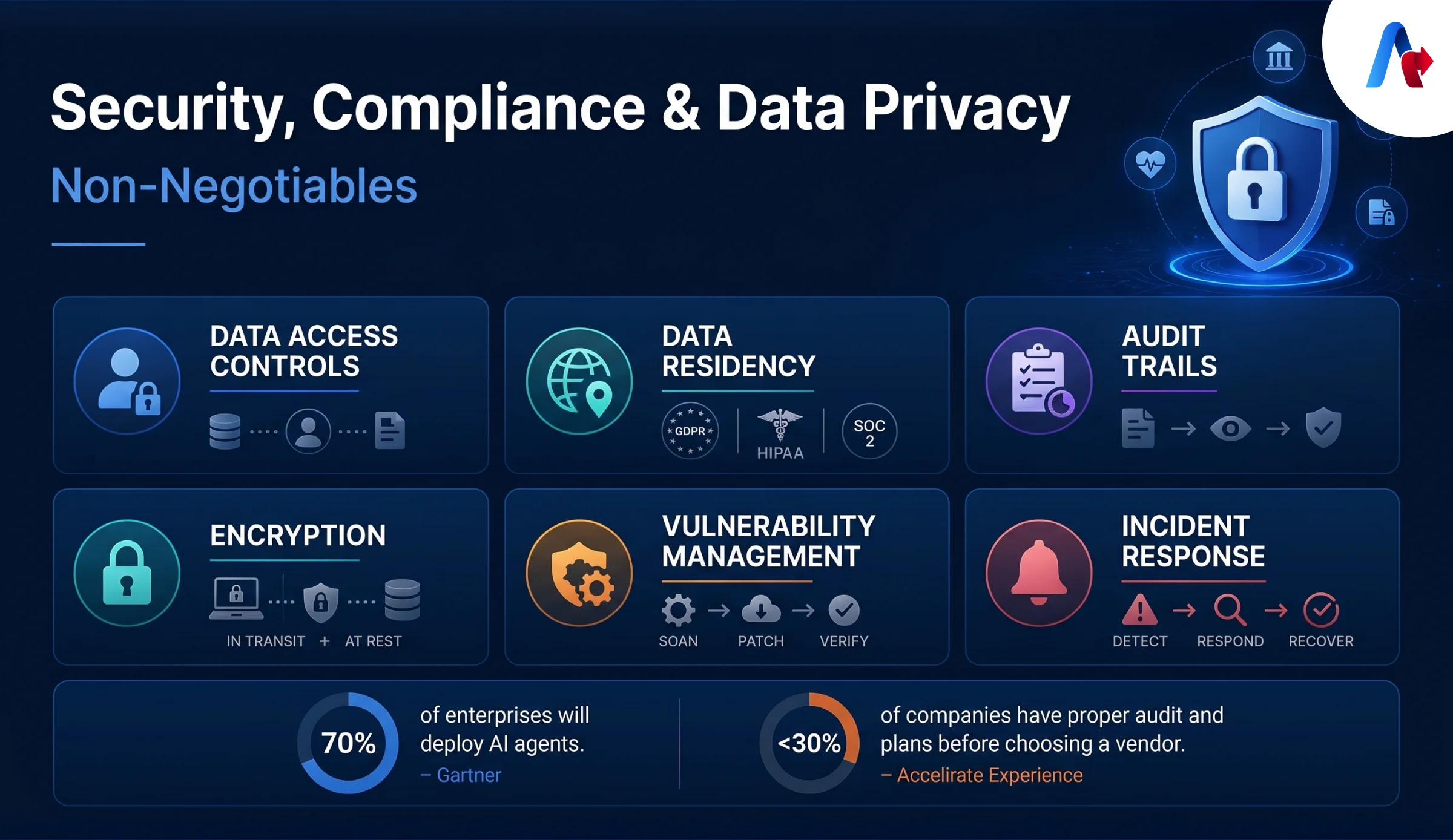
For integrating AI agents with legacy systems, this question is not an option but a necessity because it is a fundamental requirement. An AI system interacts with sensitive systems, reads data, and makes decisions. Industries like banking, healthcare and insurance have clear compliance and security to manage.
Your question in this section should cover:
- Data Access Controls: Which systems and data fields can the AI agent access? How is access scoped and limited? Who can change those permissions?
- Data Residency: Where is data processed and stored? Does your vendor's infrastructure comply with your jurisdiction's regulations (GDPR, HIPAA, SOC 2, etc.)?
- Audit Trails: Can you produce a complete record of every action an AI agent took, why it took it, and what data it accessed? It is essential for compliance audits.
- Encryption: Is data encrypted both in transit and at rest? What standards are used?
- Vulnerability Management: How does the vendor handle security patches and updates? What's their process if a vulnerability is discovered?
- Incident Response: If something goes wrong, such as an agent acting unexpectedly or data being leaked, what's the remediation process?
A study by Gartner shows that 70% of enterprises will deploy AI agents. In Accelirate’s experience, fewer than 30% of companies had proper audit and compliance plans before choosing a vendor. It means that security and compliance should be planned before AI agents go live, not after.
Before integrating AI agents with legacy systems, you need to make sure you have clear answers to all 10 questions. As an organization, ensure three things: integration approach, data readiness, and security.
If you feel any of these areas are unclear, pause. Fix the gaps first. A well-planned integration saves time, reduces risk, and ensures your integration delivers more value.
Are you confused about which integration method fits your legacy stack? We have an expert team who can help you with all queries.
Talk to a legacy integration specialist today.The 10 Integration Questions Checklist Your Team Should Ask Before Vendor Selection
A company can use this checklist of 10 questions before integrating AI agents with legacy systems:
- How will AI agents integrate with our existing systems—APIs, RPA, or both?
- Will we need to replace or rebuild any part of our current systems?
- What happens to existing RPA bots after AI agent integration?
- What specific legacy systems have you already integrated AI agents with?
- How long does a typical integration take for systems like ours?
- What happens if our data is incomplete, inconsistent, or spread across systems?
- What level of human oversight is required?
- Can AI agents reuse our existing automation workflows?
- Can you provide a live demo or POC using our use case?
- What security, compliance, and data privacy measures are in place?
What Comes After the Questions
Asking the right questions is essential to getting you to the right vendor. It doesn’t mean that the work stops there. The most successful AI integrations with legacy systems need these common traits: they start with a focused use case rather than a broad platform rollout, they involve both IT and business stakeholders from day one, and they treat the first implementation as a learning experience.
It is also vital to have a partner who helps with integration challenges early, adjusts the approach and plan. That's where Accelirate can help. We've spent years helping enterprises in banking, healthcare, insurance, manufacturing, and beyond navigate the real complexity of integrating AI agents with legacy systems.
Our experts helped to bridge systems that didn't have APIs. We've preserved RPA investments while extending them with agentic capabilities. Also, our team helped to design governance frameworks that satisfy compliance teams while still allowing AI to operate at scale.
Choose AI Agent Integration for Legacy Systems with Accelirate
Integrating AI agents with old systems is not very complex if you have the right approach. The success depends on how you plan, come up with the right questions and the right partner like Accelirate. When you have a clear idea about your system, preparing data and validating through use cases, the introduction of AI automation offers real value instead of adding confusion.
As a reliable partner, we don’t just plug AI into your systems and hope it works. Instead, our team takes a practical approach from pilot onwards, works with your existing architecture, and scales only when it delivers results. Our agentic model combines AI with automation that not only helps you move faster but also keeps costs under control.
By coordinating with us, you get:
- Faster implementation with real business use cases.
- Get up to 40% ROI through better automation strategies.
- A scalable model built around your current systems.
- A cost advantage model compared to traditional service providers.
If you are integrating AI agents with legacy systems, don’t rush yourself. Instead, ask the right question to get more clarity, so that you can work with a team that can understand AI and enterprise systems.
Is your legacy system ready for AI agents? Get ready for a free legacy integration readiness assessment to ensure connectivity, data quality, and governance gaps.
Book your free assessment.FAQs
APIs are not always necessary. It is the cleanest and fastest way to connect AI agents to existing systems, but many conventional systems don't have them. In those cases, prefer RPA to act as a bridge. Most enterprise AI agent integrations use a hybrid method that includes APIs where possible and, if not, RPA.
Yes, they can work together if you have a good strategy. Let RPA handle repetitive and rule-based tasks, whereas AI agents take charge when decision-making and complex scenarios arise. In legacy environments, AI can guide and trigger RPA bots, so that automation efforts will be more flexible and efficient.
For a normal enterprise integration (connecting AI agents to an ERP, a CRM, and one additional legacy system), it may take between 8 and 20 weeks. The timeline mostly depends on the availability of APIs, cleaned data, support from the IT team, and compliance checks. You need to be very careful of vendors who promise a timeline without reviewing your environment.
Of course, it works based on integration and a plan. AI automation can connect through APIs, middleware, or even RPA when direct access is not available. Agentic technology doesn’t need a complete replacement of legacy systems but works on top of them to improve enterprise efficiency and decision-making.
Related Blogs

