



MAR 9, 2026 |
What’s AI Agent-Driven Quality Engineering: The New Growth Engine for Enterprises

Quick Summary
Quality engineering is more than traditional testing because it can ensure the quality of a software throughout its entire lifecycle. It is not the quality assurance that helps only after production. Instead, QE with intelligent agents uses its autonomous ability to validate performance, security, and risk. More than that, it continuously monitors to avoid problems and ensure nothing breaks your application. In this way, a team can avoid defects, security risks, and compliance issues.
Do you think the biggest problem of your business is competition? No, it isn’t. There is a small quality gap that affects your product and services more than that. For years, leaders believed quality should focus on defects, regression testing, and validation. That perspective has changed now.
Today’s products experience continuous releases, AI-driven features, and high customer expectations. A small performance issue is not just a bug; it is a revenue risk for the organization.
So, the leaders ask, "What is quality engineering today?" The answer to this is simple: It is something that gives you confidence from design to production. QE takes a proactive measure and avoids security issues and software breaking through the entire journey.
Modern software quality checking is all about reliability, speed, and scalability to business KPIs. Through QE, you can improve trust, accelerate innovation, and support growth. Quality is no longer an option, but it’s a competitive advantage for any business.
A Shift From Cost Center to Growth Engine
The discussion of quality happened only during the release planning. Moreover, the budget allocation for quality testing was based on necessity. This mindset is changing now. Software quality strategy is part of every business, and it is given greater priority because it can lead to regulatory issues.
Modern product organizations operate in an environment where:
- Customer loyalty is fragile and experience-driven.
- Release cycles are continuous.
- AI-powered features introduce probabilistic behaviour.
- Regulatory scrutiny is increasing.
- Platform reliability directly impacts revenue.
In this context, a quality failure is not just a simple problem; it affects an enterprise's revenue. So, a QE must consider:
- Customer retention and lifetime value
- Time-to-market acceleration
- Brand trust and digital reputation
- Operational scalability
- Innovation velocity
How Quality Engineering and Testing Protects Revenue and Reduces Risk
As a provider, you may use subscription and platform-based business models. During the downtime, it will affect the customers directly and cost money. This is why software quality testing has its role.
A mature quality assurance will focus on shift-left and shift-right validation during development and continuous monitoring in production. Software teams should also focus on performance, validate integrations, and establish strong observability criteria for testing.
This is why systematic quality control services matter. Through this standardized method, a business can reduce costs, limit post-release fixes, and protect brand trust. Know that quality is a proactive approach, not something you do only when a problem arises.
Don’t wait for a production issue to stop your software. Early action can prevent risks and improve trust among your customers.
Schedule a free call todayAccelerating Innovation Through Intelligent QE Services
An action like QE is not complete without intelligence. This is why companies prefer AI-driven personalization, recommendations, and automated workflows that support more learning behavior.1
If your QA team is still using traditional testing approaches, it is not sufficient for:
- AI model validation
- To control prompt behavior
- Find data change
- Continuous experimentation to ensure quality
Modern software quality testing includes agentic testing, data evaluation, and risk-based test prioritization. With these better practices, a QA team can experiment safely without affecting innovation.
“According to Deloitte State of AI in the Enterprise, companies that adopt AI while following disciplined engineering practices can scale faster and reduce operational risks during digital transformation.”
This research shows that quality engineering and assurance services can help innovation move faster when risk is controlled.
Customer Experience (CX) as a Competitive Advantage
In competitive markets, CX is the most important factor for users, not features. Customers stay if the products and services are fast, smooth and reliable. On the other hand, if software lags, crashes or behaves unpredictably, they leave the platform.
With an AI software quality strategy, the team can check various aspects, such as response time, cross-device behavior, integration issues, compliance, and security.
“Forrester’s 2025 Global Customer Experience Index Ranking shows that companies that prioritize CX outperform competitors in growth and revenue.”
This report explains the real importance of customer experience. In the modern era of development, QE managers consider quality an integral part of product design. Because of this, they embed intelligent testing with automation while building the application.
Connecting Quality First Engineering to Business Performance
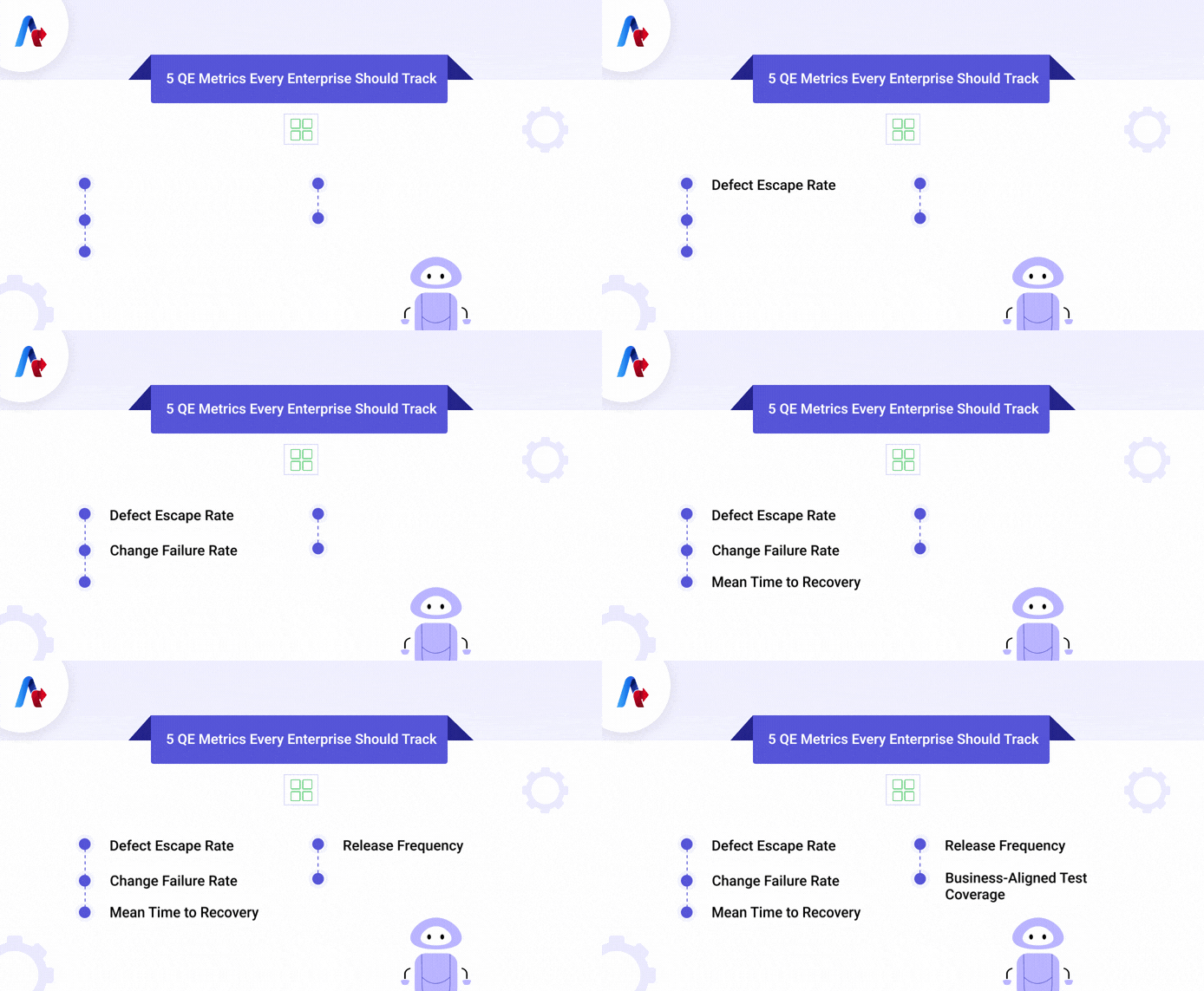
The software quality testing team earlier cared about only passing or failing. Quality checking services with intelligent automation can give leaders more measurable insights than that. When quality metrics connect to revenue, stability, speed, and decision-making, it becomes strategic for an organization.
-
Defect Escape Rate:
It shows how many issues reach production. A high escape rate means you can expect customer dissatisfaction and emergency fixes.
-
Change Failure Rate:
Frequent releases are normal in software development. But how many of those changes fail? This metric indicates release stability and quality.
-
Mean Time to Recovery (MTTR):
Incidents might happen with every system, but the question is how quickly systems recover. Lower MTTR indicates a problem that affects your customers and their experience.
-
Release Frequency:
A higher release frequency with low failure rates indicates the quality of your engineering. It shows that quality processes are improving speed and stability, not slowing down.
-
Business-Aligned Test Coverage:
Modern engineering maps test coverage to business capabilities. It helps leaders see how quality supports the direct ROI.
Read: AI Testing Agents Explained: Automating QA for Maximum Efficiency
The Role of QE in the Age of AI and Automation
The arrival of generative AI has changed the rules of product engineering. Once, it was predictable with RPA because it gives you fixed input. AI test automation is different, and if not properly monitored, it can behave differently. This is where quality engineering services become more essential.
Hallucination is a significant problem for autonomous agents and degrades over time as data changes. Once it happens, the outputs may be technically correct but contextually wrong. Now, you face a behavioral risk without monitoring.
Modern testing services address these issues. With structured evaluation sets, LLM validation, bias testing, safety checks, and continuous monitoring. With this modern method, testing no longer ends at release; it is validated continuously.
Without strong quality services, AI adoption creates regulatory, reputational, and operational problems. Think about a situation where your AI automation violates GDPR. This leads to penalties, and you can mitigate these issues with proper testing and monitoring.
Building AI-driven products for your business? Accelirate can help you get started with our expertise in quality engineering consulting.
Schedule a call with our expertsScaling with Confidence: The Role of Quality Engineering and Assurance
Growth sounds great initially, but when you move to new markets, regions, or industries, there are many complexities. This comes in the form of higher traffic loads, diverse user behaviors, regional regulations, and new integration requirements. At this time, quality control can help companies sustainably expand.
A quality test can support:
- Localization testing
- Performance benchmarking under regional loads
- Compliance validation
- Integration with regional systems
With proactive testing, organizations can enter new markets without any stress. Growth must increase opportunity, not risks, and it is easy when you are with agentic AI testing.
Why Product Leaders Must Own Quality
In this competitive world, software quality builds trust and drives more business. With this point in mind, top leaders should consider quality as a strategic advantage when building an app and continue it even after release. And this is very relevant in this AI-driven world.
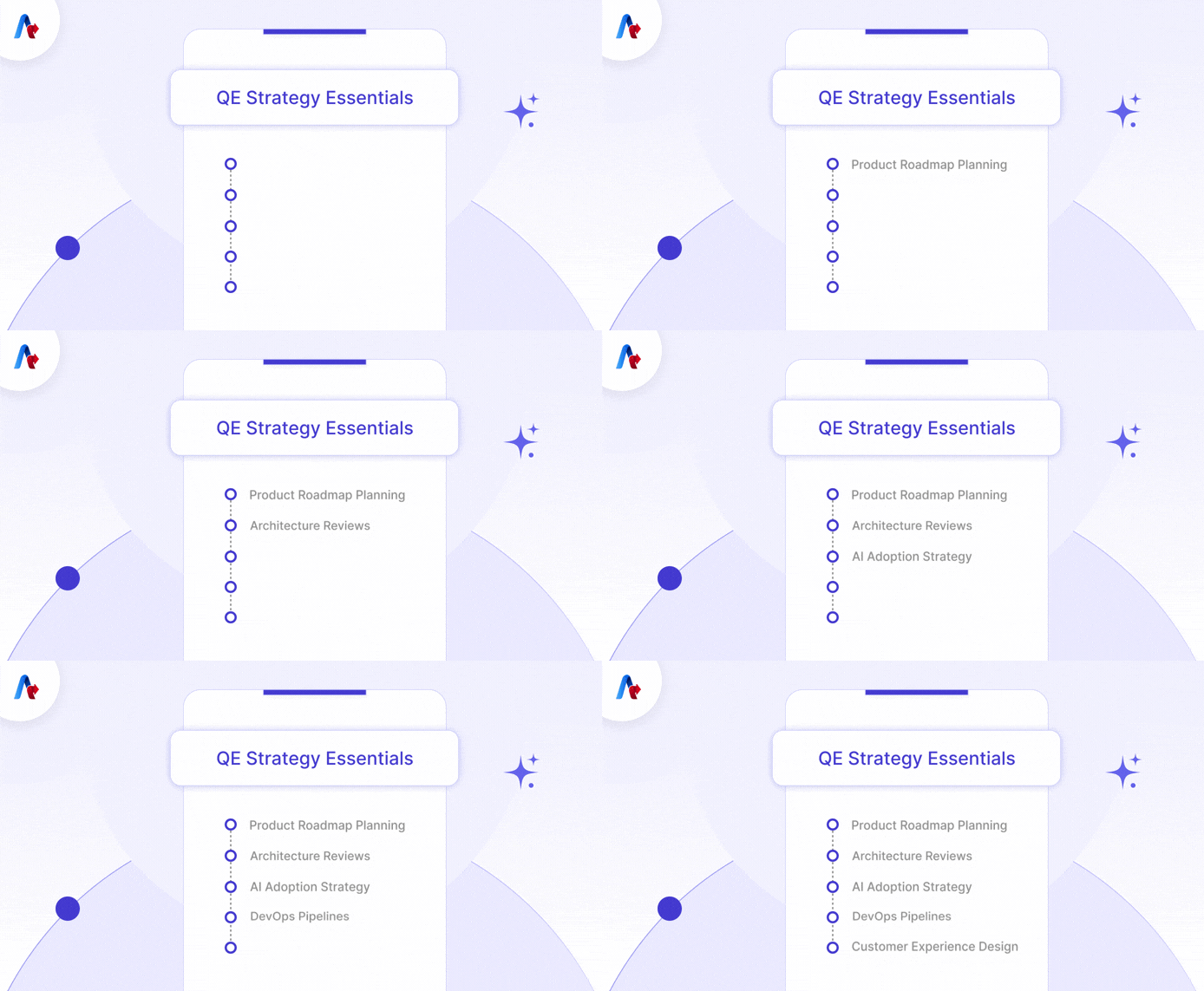
When you keep quality aside, it leads to unnecessary costs, breakdowns, launch delays, and, finally, affects the CX. A strategy must include:
- Product roadmap planning
- Architecture reviews
- AI adoption strategy
- DevOps pipelines
- Customer experience design
With all these planned points, development not only speeds up but also improves quality. By doing so, your customers get greater satisfaction and become brand ambassadors of your product and service, which ultimately leads to predictable growth.
Turn Engineering Quality into Your Growth Strategy
The digital world is moving faster today, driven by faster releases, new features, and AI capabilities. If you are expecting sustainable growth, that doesn't come from speed alone. It comes from trust, consistency, and a better customer experience.
QE is a better option here to prove these values. Mature quality engineering services in a company reduce failure rates, improve release confidence, and protect brand goodwill. Now, the QA team's action moves from reactive to proactive, so they can operate more effectively without frustration.
Modern software testing and engineering ensure scalability and governance, providing a better journey for all customers. Those leaders who treat QE as part of their routine not only build better tools, but they also build a more resilient business.