



JAN 29, 2026 |
How to Claim ROI Test Automation from Day One Using Agentic AI

Quick Summary
ROI test automation becomes visible when you design QA from the start. Traditional testing has limitations in presenting results, since it focuses only on speed and coverage. With Agentic AI testing, an enterprise can prioritize high-risk areas, track ROI continuously, reduce costs, scale effortlessly, and improve decision-making in this fast-changing AI environment. This QA method presents results to leaders and enhances their confidence in the investment.
There is no doubt that automation improved quality, but leaders frequently ask where the ROI is. It is a frequent question that Quality Engineering leaders hear after implementing automation in testing. The software release cycles are shrinking, so testing cannot survive only on speed alone, but it should show more outcomes.
This question has pushed ROI test automation into modern QA conversations, especially with the rise of agentic AI. It goes beyond technology and operates as a business value system.
The focus here is not on how many agents you have during testing, but on how quickly you can achieve test automation ROI. By strategically designing results, an enterprise can deliver better results that help it move forward and convince every stakeholder.
ROI Test Automation Is Engineered, Not Assumed
Most QA initiatives fail to prove ROI. Teams invest in tools, frameworks, and automation at scale and assume everything will change naturally. This approach can increase the maintenance costs and lead to frustration.
This is why teams must engineer AI in test automation from the start, rather than expect results later. Agentic Testing begins with ROI hypotheses, not tools alone. Before deploying agents, there are three important questions to consider:
- Which business risk or cost are you trying to target?
- Which QA activity is consuming more time or effort?
- What metric will leadership accept as proof of value?
By answering these questions, the QA team will be able to measure outcomes rather than technical ambition. With these, ROI in software testing becomes intentional, transparent, and defensible from the beginning onwards.
Not sure where your automation ROI stands? Let’s see how agentic AI helps teams design ROI from day one.
Schedule a Free Call with Our ExpertHow ROI with Agentic Testing Is Built

ROI doesn't happen by accident; it depends on how you apply the automation. A team must evaluate many factors before implementing, such as where agents are applied, how they operate, and what risks they address. Also, think about how humans and agents work together, and how value is measured continuously.
1. ROI-Led Use Case Selection (Where Teams Deploy Agents First)
Every problem does not qualify for an agentic automation. If you use Agentic Testing for every task, it will end up with slow results. To make ROI test automation more visible, introduce AI where it has the greatest impact and is easiest to measure.
High ROI is possible where effort, cost, and risk are already visible. Some of the common examples are:
- Regression suites have a high maintenance cost. It is where the QA spends most of their time.
- Look for areas where you require heavy programs with frequent changes.
- Integration and API testing with limited visibility, as it affects later stages.
- AI and chatbot validation. It will take a lot of manual effort as you scale.
Why this matters for ROI
By targeting cost-intensive QA activities first, enterprises can ensure a successful outcome without frustration. More than that, you see tangible savings within weeks. It also leads to cost avoidance, faster feedback cycles, and reduces dependency on manual effort. Most importantly, teams can convince leaders with more data and justify the expansion.
2. Agentic Testing as an Operating Model (Not a Tool Layer)
Most QA thinks that AI agents are just another tool in the arsenal. To achieve Agentic Testing ROI, it must function as a structured operating model with direct responsibility for the ROI.
Example Agent Layers and Their ROI Contribution
Let’s see some examples and their details.
A. Requirement Validation Agents
This type of AI is useful for detecting ambiguity, gaps, and contradictions early.
-
ROI:
They can reduce rework and mitigate defects
B. Test Discovery & Generation Agents
They are good at auto-generating test scenarios from requirements, APIs, and workflows.
-
ROI:
Reduce 40–60% test design effort
C. Automation Generation Agents
These agents convert test scenarios directly into executable automation.
-
ROI:
Enterprises can scale automation without much headcount.
D. Execution & Analysis Agents
This group can run risk-based tests and analyze failures intelligently in advance.
-
ROI:
It will reduce regression cycles and speed up your release decisions.
3. Shift from “Test Coverage” to “Risk Coverage.”
Traditional Quality Engineering will mostly focus on only one question: How much did we test? The coverage is easy to report, but the real business impact is difficult to explain. If you want to improve ROI test automation, the focus must change from volume to risk reduction.
Now, the question is very clear: What risk did we reduce or eliminate? Agentic systems can work with this mindset. Instead of testing everything, they prioritize everything based on business impact, recent changes, and failure patterns. Through this method, it is possible to avoid low-value tasks and prioritize those that require deeper attention.
ROI Effect
- Test only with what is necessary, and this will improve confidence.
- It will reduce wastage when you are doing important work.
- This type of testing can improve decision skills and faster releases.
4. Human + Agent Collaboration
There is a misunderstanding that agentic AI can replace all testers in an organization, but that is not the case. This technology can improve the capability of the tester, and human agents are still valuable here. The QA team can use this collaboration of humans to improve the quality, not to replace them.
-
How does this work:
Let agents handle the high volume of testing, repetitive work and analysis. Humans are highly valuable for judgment, exploration, and strategy. This distribution is essential for testers, as it allows them to spend their time on other tasks where they need it most.
ROI Outcome
When you remove repetitive work, testing quality will increase, and the team will save hours. If the work is creative and not repetitive, morale will increase, which improves retention.
5. Continuous ROI Tracking, Not One-Time Justification
Many testing initiatives offer benefits at once, but the agentic test automation is a different one. Here, this tracking is not a one-time effort but a continuous one as part of QA governance.
With this innovation by your side, testers can see the visible result soon. It can include hours saved per release, defect reduction, regression cycle time trends, and cost avoided through early defect detection.
The team and leadership can regularly review the metrics and adjust how agents work, comparing them with the original ROI goals. Gartner also advises this method for AI projects. It says that measuring and continuously improving are vital for high ROI, rather than relying on a single-time estimate.
Read: Agentic Testing: Optimizing Test Automation with AI Agents to Boost Productivity
Do you want to know how this method works in your testing? ShapePartner with us to design a better ROI with agentic power.
Get StartedComparative Analysis: Relevance to the Current Industry Landscape
The way we QA is changing fast. With more innovation coming, what worked a few years ago no longer fits today. Let’s see why ROI test automation matters now and why it is important to check the current industry reality across sectors.
1. Industry Reality Today
The release cycle in banking, healthcare, insurance, retail, and SaaS is shrinking due to more updates. In this AI-driven world, testing complexity is increasing, and with a traditional approach, you cannot keep up.
If your team is depending on manual validation, it is difficult to scale. As costs rise, leadership demands justification and measurable ROI for every automation initiative.
According to Gartner, worldwide AI spending can reach $2.5 trillion by 2026. The investment is booming, but many organizations are struggling to prove ROI as they scale AI initiatives. For this reason, leaders are demanding clear cost justification and measurable ROI for every automation and testing initiative.
2. Where Traditional QA Falls Short
Traditional QA today not only struggles with delivery speed but also with system complexity. More importantly, the ROI result is hard to prove with this method. The high maintenance cost is also another problem with the old method that will affect the whole testing process.
In many organizations, testing is still considered a delivery expense. With this perspective, it will be very hard for leadership to connect testing activity to outcomes. As a result, the software testing results remain unclear, limited by traditional methods.
3. Why Accelirate’s Model Is Highly Relevant
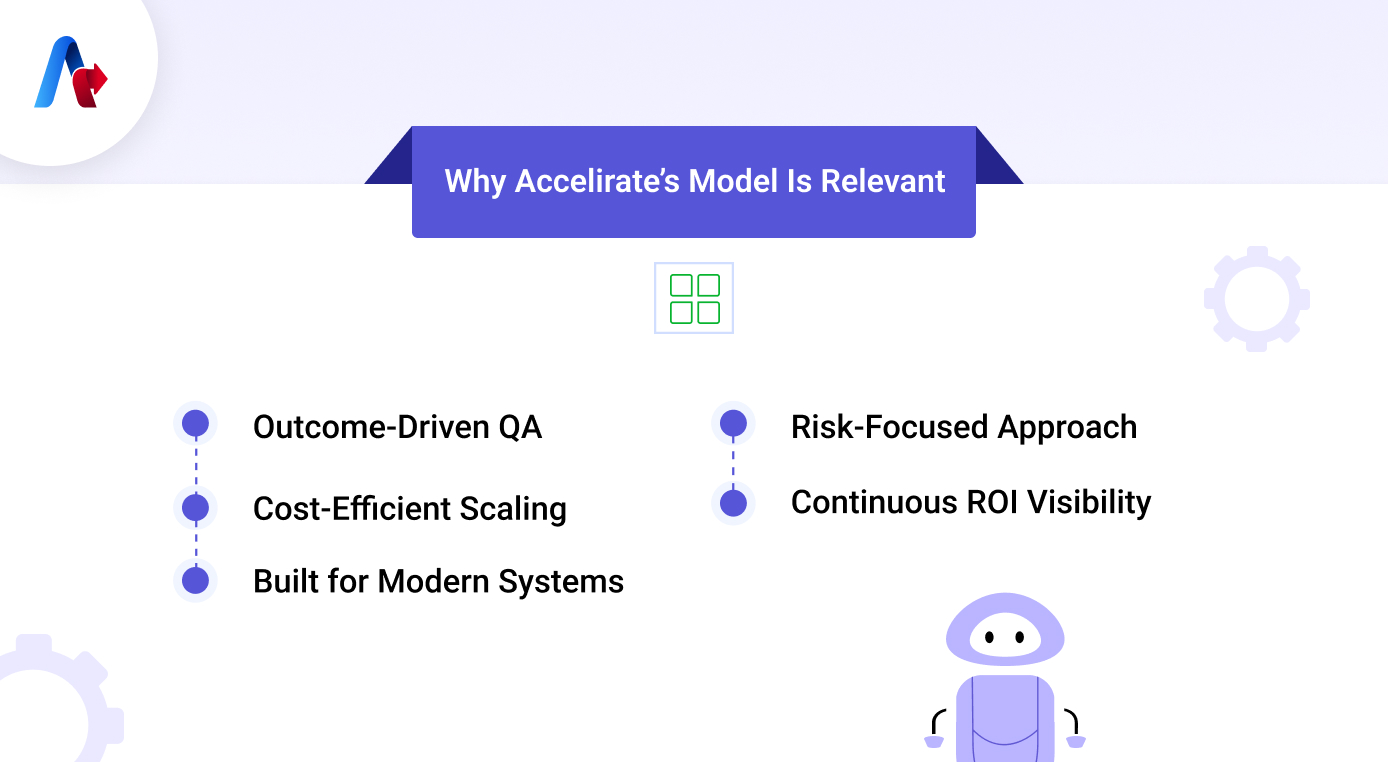
Accelirate’s AI automation testing service is unique because it fits today’s industry needs. It mainly focuses on outcomes and complexity. A method like this can improve value and output. It speaks the language of leadership by improving business value, reducing risk, and controlling testing costs.
This approach is relevant because:
- It connects testing directly to business outcomes.
- Helps teams improve quality without high cost and headcount growth.
- Supports AI-driven, API, and integration-focused systems
- It will provide continuous ROI evidence as you move forward.
If you want to justify your spending with the right ROI, Accelirate’s quality assurance approach delivers measurable value, not just speed alone.
Essential Read: How Accelirate’s Agentic AI-Led COE Saves Over 40K Hrs and 65% Costs in Testing for a Global Bank
Build ROI into Agentic Testing from Day One
Agentic Testing is not delivering ROI because of AI’s power, but it’s how you design it. Think about it as a strategic investment, so the outcome becomes measurable and defensible. By focusing on risk-based execution, human–agent collaboration, and continuous tracking, the QA can keep costs under control.
When you have that perspective, ROI test automation is measurable with faster releases, lower risk, and smarter decisions. In today’s environment, designing agents with the ROI is not an option but a necessity.