



Quick Summary
The QA team in different enterprises is realizing the importance of multi-agent testing due to its ability to handle workflows such as UI, APIs, integrations, and continuous changes more effectively than single AI systems. This type of automated testing can adapt to challenges, understand system behavior, and self-heal issues before they affect your entire system. A team that relies on this type of QA can improve testing coverage, mitigate errors and save costs.
Imagine a situation where you run a set of teams for testing, each focused on specific tasks toward a particular goal. It is the same idea that exactly works in multi-agent testing systems. Here, the concept is simple. A group of AI agents or LLMs works in a given situation and produces the best results possible.
These agents work like a coordinated crew. For example, one agent focuses only on UI testing, whereas the other handles API testing. In this way, each agent will have a specific target to complete. This method is a shift away from the old single-style testing and avoids the complexity of modern applications.
A single-agent system struggles across many testing areas. It may miss the interactions and leave blind spots that cause serious problems in your software. It is not the case with a multi-LLM workflow because they can communicate, coordinate, and validate everything to make your testing smarter and faster.
A Gartner report predicts that 40% of enterprise applications will include task-specific AI agents by 2026. It is only 5% today, which clearly indicates that companies are moving to AI systems, especially multi-agent production. Let’s discuss what a multi-agent method is, why it is crucial, how they work and where it fits in your strategies.
What Are Multi-Agent Testing Systems?

Multi-agentic testing is a system in which many agents coordinate to achieve better results. In this automated testing, each agent will take a specific task and pass it to the next for completion. This process will continue until they finish their target.
The traditional single-agent system performs all tasks on its own. In such scenarios, the AI's ability is complex, and its results may not be appropriate. When multiple agents handle different parts of the building, such as security testing, logic testing, and database testing, they can perform well because they handle only a single job.
In short, they share their work, findings, and coordinate to improve reliability and the depth of analysis. If an agent finds something suspicious, it may request a deeper inspection and may ask a specialized agent to evaluate it. This type of workflow is suitable for today's challenging and enterprise-grade AI workflows.
Need more details on agentic testing? Read: AI Testing Agents Explained: Automating QA for Maximum Efficiency
The Limits of Single-Agent Testing in Modern AI Workflows
A single-agent system is not fit for today’s challenges, as it completes every task on its own. An enterprise may use hundreds of integrated components, such as UIs, APIs, and third-party integrations.
In order to get the coordinated results and data, this AI must go to all these areas alone and get the things it wants to produce the results. It is best for isolated and predictable workflows, but today’s work is not like this, where AI automation must go to different areas and applications to complete its tasks.
Another problem is the specialization. An AI agent trained to do a specific job in testing can perform better than an AI that does everything from top to bottom. Here, the problem is that it may miss many important details because it has to cover every domain at once.
There is also another issue with the poor visibility into cross-system interactions. Many failures do not happen inside one component. Instead, they happen when systems interact. Single-agent often evaluates components in isolation, making it difficult to identify issues early.
It also struggles with context-related issues, especially when the workflow is more difficult. This will increase the risk as it may leave some areas untested. And the single AI system may struggle with changing systems, updates and changes. A system like this not only slows down your work but also risks your business.
Why Enterprise-Scale AI Demands Multi-Agent Validation
The use of artificial intelligence is growing across teams and different platforms. Now, it is not just about how they work in isolation; instead, companies evaluate how they work together by coordinating everything, especially in quality assurance. Some of the reasons are:
Enterprise AI is Deeply Interconnected
When you look deep, you see that there are many things connected in enterprise AI workflows, such as front-end interfaces, backend services, APIs, data stores, and external platforms. If you make a small change in one layer, it can silently affect another layer. A traditional testing method is not ideal here, as it can only check parts separately.
A multi-agent testing system is not like this because the different agents will observe different things at the same time, helping you to get a clear view of what happened and find issues more easily than before.
Single Agentic Testing Struggle with Load
The old method is suitable for low-complexity scenarios, but this is not the case now. It was built with the intention of handling low- to medium-level tasks, but the working conditions are pretty different at the enterprise level.
More than that, the complexity will increase in the future, making it harder for one agent to provide contextual output. There are other problems like delays, misbehavior and more dependencies that may cause risks and failure in automation testing.
Speed Matters
Enterprise AI systems need more speed, adaptability and feedback. It is difficult if you are using one agent for all the jobs. New features, model updates, and integration changes happen in parallel across an organization, and this can slow down the entire process.
Multi-agent testing allows you to cover across workflows, components, and scenarios. By using this method, a team can validate deeply, which is critical for large teams and continuous deployment environments.
Comprehensive Security and Compliance
This is another area where multi-AI testing shines. Each security and compliance agent will protect your organization from major attacks, such as SQL injection attacks and data leakage.
These AI-powered automations are different from the conventional system as they ensure role-based access control, end-to-end encryption, and real-time monitoring. Security and compliance are essential and not negotiable, especially in sections like finance and healthcare.
Accuracy and Continuous Improvement
In a multi-agent system, accuracy is higher because each AI validates everything, especially context. When one agent passes a task to another, it evaluates the shared data and communicates if anything is wrong. In this way, you achieve greater accuracy than with a single-agent system.
Finally, a normal AI can affect the time due to data issues and changing conditions. It is different from the other system because the multi-agent workflow continuously monitors and evaluates whether the agents are following organizational goals as per the changes.
Not sure how multi-agent testing would fit into your current QA setup?
Talk QA Expert NowCore Concepts in Multi-Agent Testing Architecture
Multi-agent QA is not about adding as many agents as we can. In this method, a specific AI performs the different parts of testing by collaborating with others. Let’s look into the core concept of this system to learn more about how this system works.
Specialized Agents with Clear Responsibilities
A testing that works with several agents is different from a single-agent workflow. Let's take an example of four agents where the first one focuses on user interactions, the second agent on API responses, the third one checks on data consistency, and the last one handles only logic or error. This method will reduce confusion and improve depth.
Connected Context and Communication
Although these tests work independently, they are tied together through test results, logs, and changes. When there is an issue, they communicate with each other about the findings. If an API-testing agent found an unexpected response, it can pass that information to a UI agent for further validation.
Orchestration and Coordination Logic
Behind the scenes, an orchestration layer decides various functions. It will decide which agents run first, which agents run in parallel, and when the agents will follow the tests. This coordination ensures that agents follow a logic to avoid duplication.
Design Patterns for Multi-Agent Test Orchestration
Reliability is crucial for a multi-agent testing system, and that is possible when there is a clear orchestration pattern. It defines how agents are coordinated, when they act, and how they move forward with the results.
The following patterns are common in the real-world testing workflows.
Pipeline Orchestration

In this pattern, agents run one after another in order to complete the job. Each agent completes its task and passes the output to the next one.
This method perfectly matches the testing, because:
- One test depends on the other’s result.
- Validation must follow a strict workflow.
- If it fails, it should stop further execution.
Parallel Orchestration
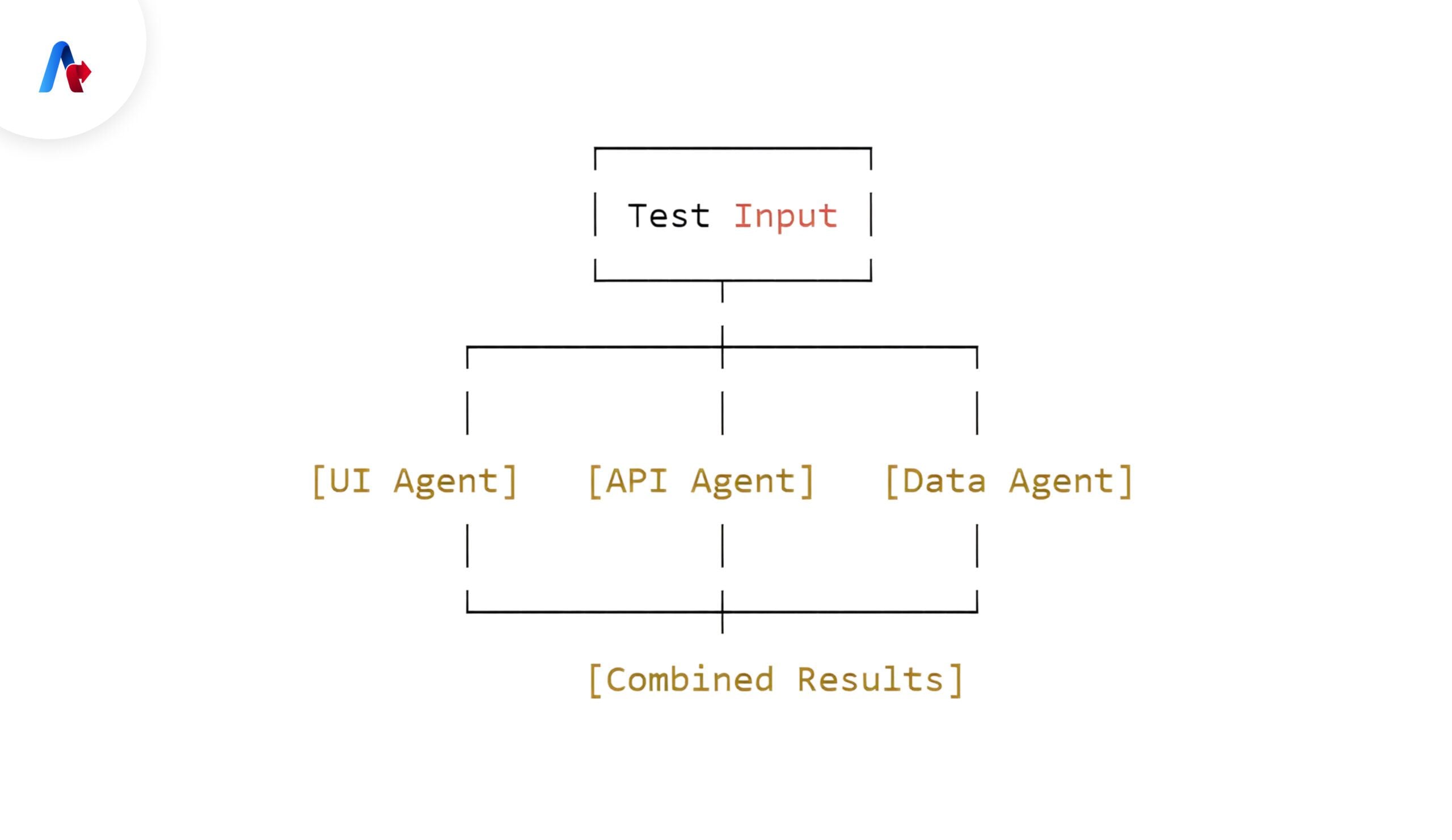
Here, multiple agents run at the same time. Each test tests a different part of the system. Finally, the results will be collected. This type of multi-agent testing system is useful when components are independent, speed matters, and a broad coverage is needed quickly.
In a testing scenario, this method allows UI, API, and data agents to validate the system simultaneously.
Coordinator Pattern
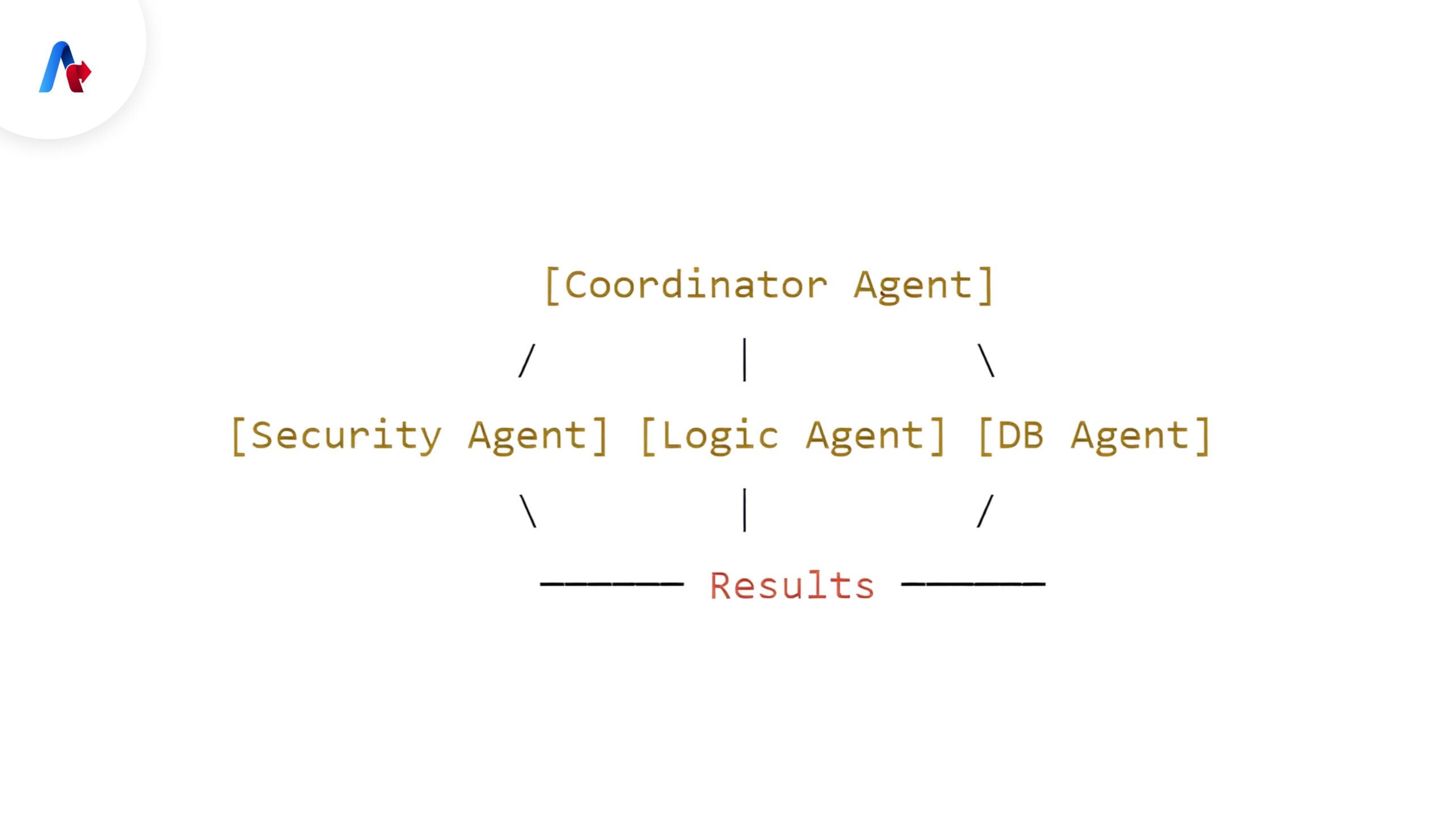
The coordinator orchestrator combines everything from assigning tasks, monitoring progress, and deciding the next steps based on the output that it gets from agents. A method like this (supervisor) ensures everything works in the right order.
This is very helpful for enterprise testing to:
- Maintain consistency
- Avoid duplicate tests
- Enforce validation rules
Handoff-Based Orchestration
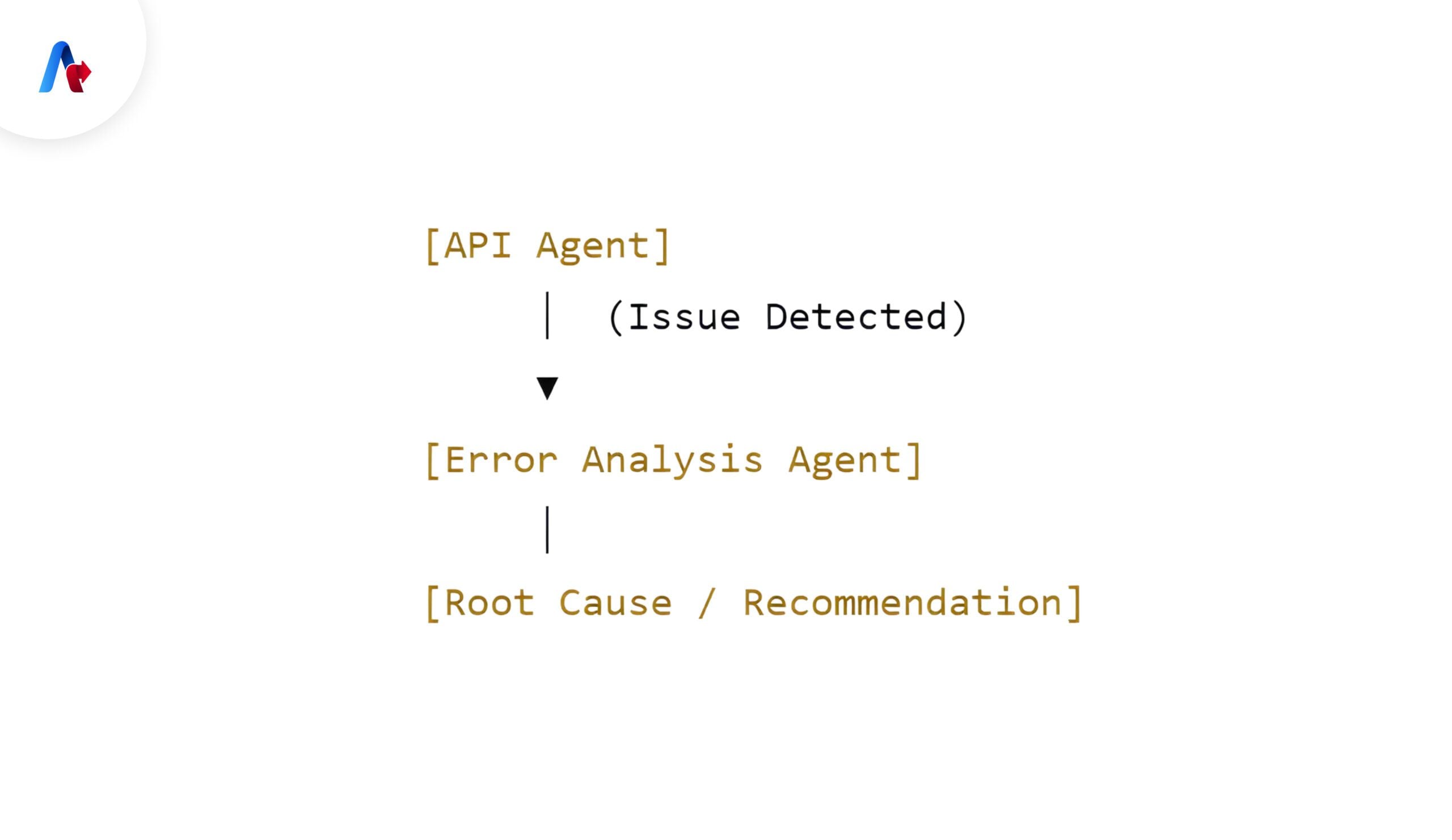
Handoff pattern is different because each agent can assess tasks and decide to hand over to the next agent for completion or to transfer to a more appropriate agent for contextual validation and requirements.
For example, while testing, an API agent detects unexpected behavior. In this situation, it can hand over the data to the error-analysis agent for more clarity. This makes multi-agent testing more effective and context-aware.
Tools, Protocols, and Standards Supporting Multi-Agent Systems
A system that works with multiple AI needs lots of tools, protocols, and supporting systems in order to function and communicate well. These things will ensure that everything goes well as planned, and finally, you get the desired result.
You may see many tools in the market, but this one is special with its abilities. With tools like Autopilot and Agent Builder, QA teams can use AI agents to create test cases, analyze application behavior, and execute validations across UI, API, and desktop systems. It also easily integrates with DevOps pipelines and release workflows.
Tools like UiPath Test Suite and Test Manager are vital parts in test execution, asset management, and traceability. These tools play a great role in coordinating automated and manual tests and provide you with better visibility for auditing.
here are other tools like Tricentis Tosca that will do jobs in testing. A codeless testing platform like this can extend its coverage across web, mobile, API, and legacy systems and support your quality assurance.
Communication Protocols
In the multi-intelligent system, agents will follow a protocol to keep testing authentic. Some are already in use, but few are just emerging.
- MCP (Model Context Protocol): This will ensure all testing agents share the same, such as application context, test data, environment variables and tool access. This is critical during test generation and execution.
- ACP (Agent Communication Protocol): It helps with structured communication between testing agents. For example, a test-generation agent sends scripts to the execution agent, the execution agent reports failures to the analysis agents, and the analysis agent flags risks to the reporting agent.
- A2A (Agent-to-Agent Protocol): An agent-to-agent protocol is essential to connect agents if necessary. In this method, the UI test agent requests API validation, and the regression agent triggers performance tests.
- ANP (Agent Network Protocol): Here, you can discover new test agents, join test pipelines and scale testing across environments. This will help with enterprise-scale test environments.
- AG-UI (Agent-User Interaction Protocol): Humans in the loop can avoid errors and ensure the testing meets the quality standards. For a final validation, a tester reviews AI-generated tests and ensures everything is right.
There are some standards, such as FIPA, for agent management and directory services that help you discover problems with your present method.
Beyond that, industry working groups, such as the IEEE Multi-Agent Systems Working Group, also focus on defining interoperable message formats and interaction semantics that align diverse platforms.
Choosing tools is easy for you, but designing agents requires experience and expertise.
Let’s see how we can work togetherCase Studies: Multi-Agent Testing in Real-World AI Workflows
A multi-agent system (MAS) is already in use in a testing system where it performs multiple steps to get the perfect outcome. Some of the use cases are:
Use Case 1: Cross-Validation in Multi-Step Workflows
In complex workflows, it is difficult to plan, collect information, and generate outputs as the information is carried by diverse agents. One agent produces something and passes it to the next, but the next one independently reviews it for completeness, logic and other essential things. By cross-checking each other, your team can mitigate errors and avoid mistakes in the software applications.
Use Case 2: Parallel Testing Across Application Layers
Modern agentic applications include several things, such as user interfaces, APIs, data layers, and third-party services. In a multiple AI-agent testing setup, agents validate each layer at the same time to save your team's effort and time.
Use Case 3: Regression Testing for Continuous Learning
AI systems that evolve through frequent updates or model changes require continuous regression testing. If you are testing with several agents, one can monitor historical behavior while others validate new changes.
This is a great advantage because it can detect misbehavior and maintain consistency across releases without slowing down delivery.
Important reading: The 3 Important Pillars of Agentic Testing: Speed, Scale & Savings
Challenges and Best Practices for Implementing Multi-Agent Testing
Like every area, this method also has its own challenges. Before you adopt, it is good to know what kind of problem you face so you can prepare for it in advance.
- Complexity in Coordination: This is a place where you coordinate several agents for testing. In some situations, it will be difficult to manage when multiple agents run tests in parallel and keeping them in order also faces some difficulties. If you miss any area, the final testing result will be affected.
- Result Consistency: There are some situations where agents produce inconsistent results. This will affect the outcome.
- Root Cause Analysis: Since there are several agents included in the testing process, it is difficult to trace their origin.
- Operational Overhead: This is another area where you face issues. If there are several agents, it is difficult to maintain configurations, permissions, and execution logic, as this places a greater burden.
Best Practices for QA Teams
These practices are important to avoid headaches and burden.
- Define Clear Test Ownership: You need to assign each agent a specific testing responsibility. For the first one, assign UI behavior; for the second, API validation; and for the third, data integrity. This is helpful for improving accountability and coverage.
- Standardize Validation Criteria: A validation criterion is an unavoidable option here. Use acceptance rules and common pass/fail criteria so all agents can evaluate results without confusion.
- Traceability and Observability: To know what happened, get capture logs, decisions, and test outputs from every agent. This is important for audibility.
- Design Reusable Test Agents: Build agents that are possible to reuse across scenarios. This reduces maintenance effort as systems evolve, so you can use them for other purposes.
Future Trends: Agentic AI, Interoperability, and Open Standards
The testing is evolving along with the new updates in artificial intelligence. So, this is going to be more than scripted automation. You can see such migration in the UiPath test suite and other testing agents, and multi-agent testing is going to be the center of this future system.
Testing is becoming more independent, where automation systems take more responsibility for different tasks in the QA process. More than writing scripts, agents are going to do more in the behavioral check, adaptation, and decide what to validate next. With this improvement, your engineering team can rely on agents that help to monitor behavior continuously rather than doing repeated activities.
The future testing environments will involve many tools together, such as test automation platforms, CI/CD pipelines, monitoring systems, and AI services. Interoperability is a new system that will give more capability without any custom integration.
Open standards for agent communication and tool access are gaining more importance, and this will increase further in the coming years. They allow testing teams to build multi-agent systems that are more flexible and extensible across more than a single platform.
The Strategic Impact of Multi-Agent Validation on AI Quality
Testing the application's quality will mitigate the burden at the last minute of your release. With the multi-agent method, this is going to a new level, where one agent takes on one part and hands off to the next for the other task. This will take testing to a new area that ensures collaboration and continuous quality assurance.
By providing responsibility to agents, organizations gain deeper visibility into how these intelligent systems behave across workflows, integrations, and real-world scenarios. This approach helps you reduce errors, strengthen regression coverage, and mitigate the risk of unnoticed failures in production.
From a strategic viewpoint, multi-agent testing with a strategic partner like Accelirate can improve outcomes, faster release cycles, and stronger governance. With this, you don’t get any issues at the time of release and ensure nothing is missing in your application.
Let’s not keep anything for the end that affects your goodwill. Partner with Accelerate for a multi-AI testing approach.
Begin with a free consultationFAQs
Multi-AI agent testing is a QA approach where numerous agents are part of validation. In this method, these intelligent systems work together for a specific goal rather than a single agent doing all the testing work. For example, one agent takes care of the UI part and the other one tests APIs. In this way, all artificial intelligence covers each part to improve accuracy and the speed of delivery.
When you take conventional automated testing, it mainly concentrates on script writing or sequences of checks. It does not go more than that, but in this testing system, many individual agents test different parts in parallel, share the results with the next, and adapt based on the findings without much human effort. This type of testing is helpful in many ways as it can cover broadly, find issues, and change as your business grows.
In QA, agentic testing means using diverse agents that autonomously generate, execute, and evaluate tests without extensive manual scripting. The agentic system is different because it can adapt to the changes and self-heal the mistakes compared to other automations. Moreover, they are better at assessing the system’s behavior, adjusting tests, and improving over time.
It is helpful to face many challenges that the testing area faces now, but it may struggle with integration and parallel execution if not properly guided. Developing teams can avoid this kind of issue with an experienced partner. Multiple AIs in testing can help you distribute different areas of work that you don’t get in other systems.
Related Blogs

