





A few years ago, automation meant bots that followed scripts. They clicked, typed, copied, and pasted exactly as told. But when anything unexpected happened like a new document format or a different customer request, those bots stopped. Humans had to step in.
Now, something different is happening. We are starting to see AI agents that don’t just follow instructions but make their own choices. They learn. They solve problems. They adjust when things change. That’s what Agentic AI is about.
How Operations Are Changing with Agentic Automation?
Businesses are growing faster and the data they handle is growing more complex and unstructured. The old way of automating things just isn’t enough anymore.
Robotic Process Automation (RPA) functions the best when it comes to simple, rule-based tasks. But it needs help handling unstructured information or unexpected changes. That’s where agentic automation works best. These AI agents are coded differently and fed with reasoning, making them capable of understanding the context. They decide what to do next and can function without constant human supervision.
In simple terms, agentic systems are designed for situations where the answer isn’t obvious and where flexibility matters. The Agentic approach is to assign complex unstructured and contextual decision-making tasks to agents while RPA continues to play its role in executing rule-based tasks alongside humans as the supervisor or leaders.
By combining the strengths of both RPA and AI Agents, enterprises across industries can identify opportunities, make better decisions and achieve faster ROI.
Related Read: How Agentic Automation Differs from Traditional RPA?
How Agentic AI Systems Work in Business Processes?
Though there are several other areas where AI Agents can empower teams, let’s talk about three function areas where AI agents contribute to making workflows faster with intelligent automation.
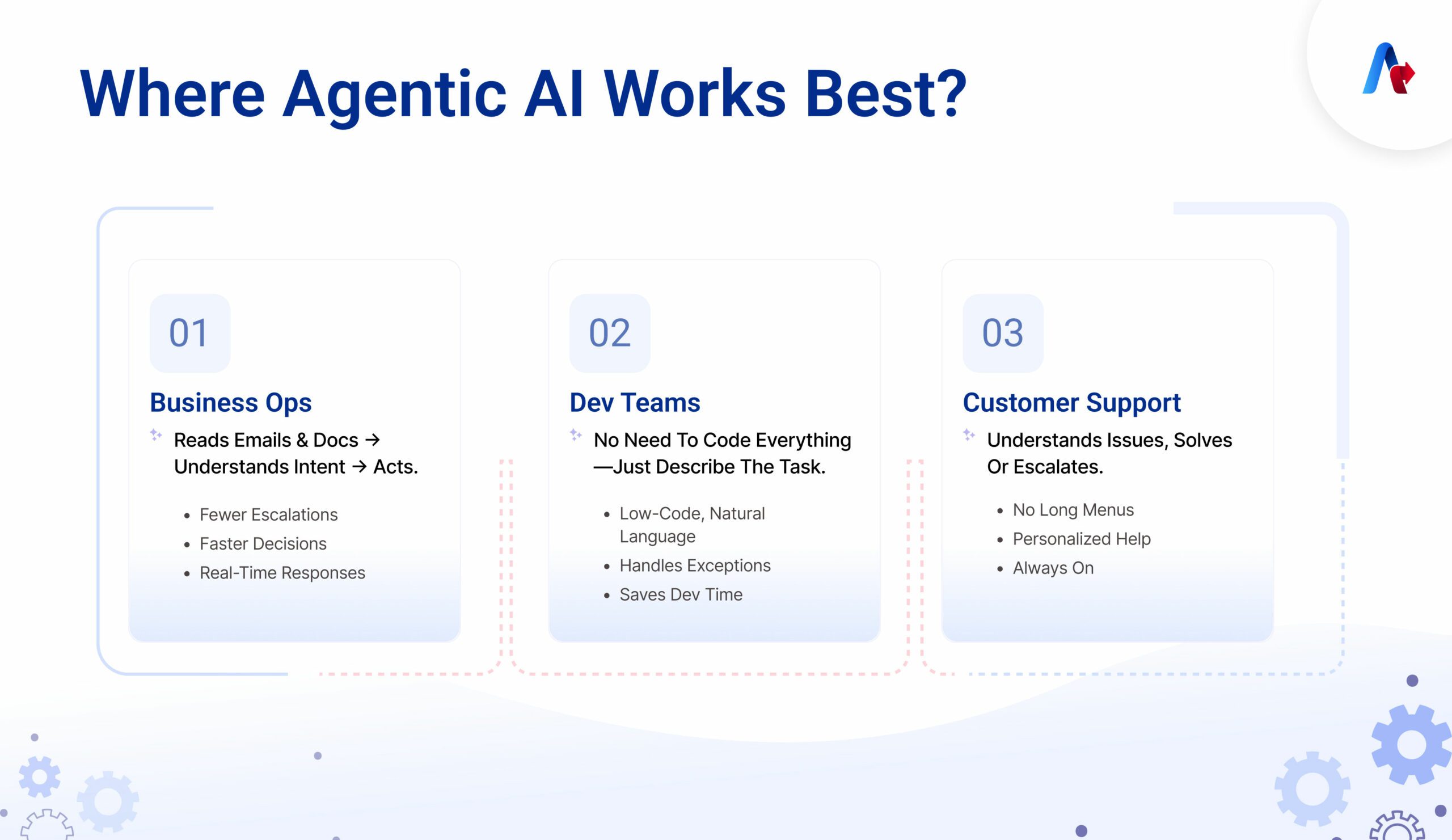
Day-to-Day Business Operations
Instead of relying on employees to manually sort through incoming emails or exceptions, we can have a tailored AI agent that reads them, understands the intent, and takes the right action on time, without needing rules for every possible scenario.
They are useful in operations like insurance claims, customer onboarding, and supply chain changes, and support in faster decision-making, fewer escalations, real-time handling of changes and continuous adjustments based on outcomes
Simpler Software Workflows for Developers
For developers, agentic AI brings a different approach. Many of today’s agentic systems use low-code or even natural language instructions. Developers can guide agents using plain text and ensure end to end process orchestration. Agents can also explain what they did or why something failed, making error handling much easier.
That makes it simpler to maintain workflows and handle exceptions. Teams spend less time writing and fixing code, and more time focusing on the outcome.
Better Customer Interactions
AI agents in customer service are proactive, adaptive, and scalable. Suppose a customer calls with a question about their bill. An agent reads their message, figures out what the problem is, and either fixes it or sends it to the right person, depending on the situation, instead of making them go through a maze of menu options.
The experience is faster, more personal, and feels more human without needing a large team behind the scenes.
Practical Benefits You Can See by Deploying AI
Agentic AI brings clear advantages when used the right way. Let’s look at some of the top ones in the list.
Increase in Productivity
By implementing an agentic (agent + robot + human) ecosystem, businesses reduce their turnaround time and improve productivity.
Consistency and Accuracy in Output
Just like robots, agents are available 24*7 and with AI capabilities they reduce human intervention, leading to fewer manual steps and lesser errors.
Costs Stay in Check
Agents are capable of handling complex tasks while robots focus on rule-based tasks. This approach reduces the possibilities of re-work, the cost to solve errors, and operational inefficiencies that could result in cost reduction spent on each automation.
Easier to Scale and Grow
The agentic ecosystem is scalable and can adapt to changing environments through its modular design, self-learning, and reasoning capabilities. Organizations can scale autonomous systems with changing trends, workloads, and business needs.
Personalized Customer Experience
Faster responses and relevant answers instantly improve customer satisfaction. Personalized experience makes customers happy and satisfied with the service.
Build and deploy tailored AI Agent in just 5 weeks.
Try our Activator Program today!
But Agentic AI Is Still Not Perfect
With all the upside, agentic AI still comes with some challenges. But the best thing is these are not major roadblocks and can strategically be managed if only we have the right planning, supervision, and a clear understanding of what the system should do.
Clear Task Co-ordination
Agents should be assigned independent tasks, and there should not be any overlap between the tasks. In the multi-agent system, this might create unexpected costs and inconsistencies.
Monitoring Matters
Proper orchestration and monitoring should be in place to oversee the agent’s performance over time.
Unclear Goals
Each agent should be meant to achieve a specific goal independent from the other agent. Unclear and misaligned goals with business needs lead to inaccuracy and inconsistency in decision-making and undesirable actions.
Potential Security Risks
Data provided to the agent should be true and accurate to take appropriate and clear decisions. Malicious data can lead to unsafe and misleading decisions.
Ethical Compliance
Agents should operate within data privacy laws and ethical compliance boundaries.
Integration Challenges
As agentic AI is still growing, integrating it with the legacy system may take extra effort.
So Where Do We Go from Here?
Agentic AI is not science fiction anymore. It’s already in use and quietly powering processes in banking, healthcare, insurance, and beyond. What’s different is that these agents don’t just wait for instructions; they take action based on context learning.
It doesn’t mean we stop using bots or humans. Instead, we bring them together. This mix is already helping companies respond faster, make smarter choices, and serve people better.
The businesses that get ahead are the ones that recognize where agents fit, not everywhere, but in the right places. It’s not about replacing people. It’s about letting them focus on what matters while the system handles the rest.
Ready to explore more?
Talk to our experts today!

More Articles

Agentic AI in 2026: What Enterprise Leaders Must Prepare for
By 2026, agentic AI will move from pilots to production. Discover what enterprise leaders must prepare for as AI agents reshape business operations.
January 22, 2026

UiPath vs. Open Source: A Test Manager’s Perspective on Choosing the Right Testing Tool
Compare UiPath Test Suite vs open-source tools like Selenium, Rest Assured, and JMeter from a Test Manager’s perspective to choose the right QA and automation stack.
November 18, 2025

Tosca vs. Open Source: A Test Manager’s Perspective on Choosing the Right Testing Tool
Compare Tricentis Tosca with open-source tools like Selenium, Rest Assured, and JMeter. Learn how to choose the right testing tool for scalability, cost, and long-term ROI.
October 21, 2025